The bread is rising. Mira asks if you'll teach her the rye loaf today, the one with the caraway, that her mother used to make.
An old man left an extra coin. He didn't say why. The engine logged it; ask him next visit.
[SYS] SYS.01 · CREATE // PLAY // RETURN · SOLO OR SHARED
Start with a sentence: a lower-league football club, a canal republic of bankers, a quiet monastery, a frontier at the edge of the map. Answer a few questions, watch the world take shape, then step in as your character. The consequences persist: what you own, who owes you, who has not forgiven you. Leave and the scene holds. Return and the world catches you up.
BUILT FOR THE LONG HAUL.
// WHAT YOU ARE STEPPING INTO
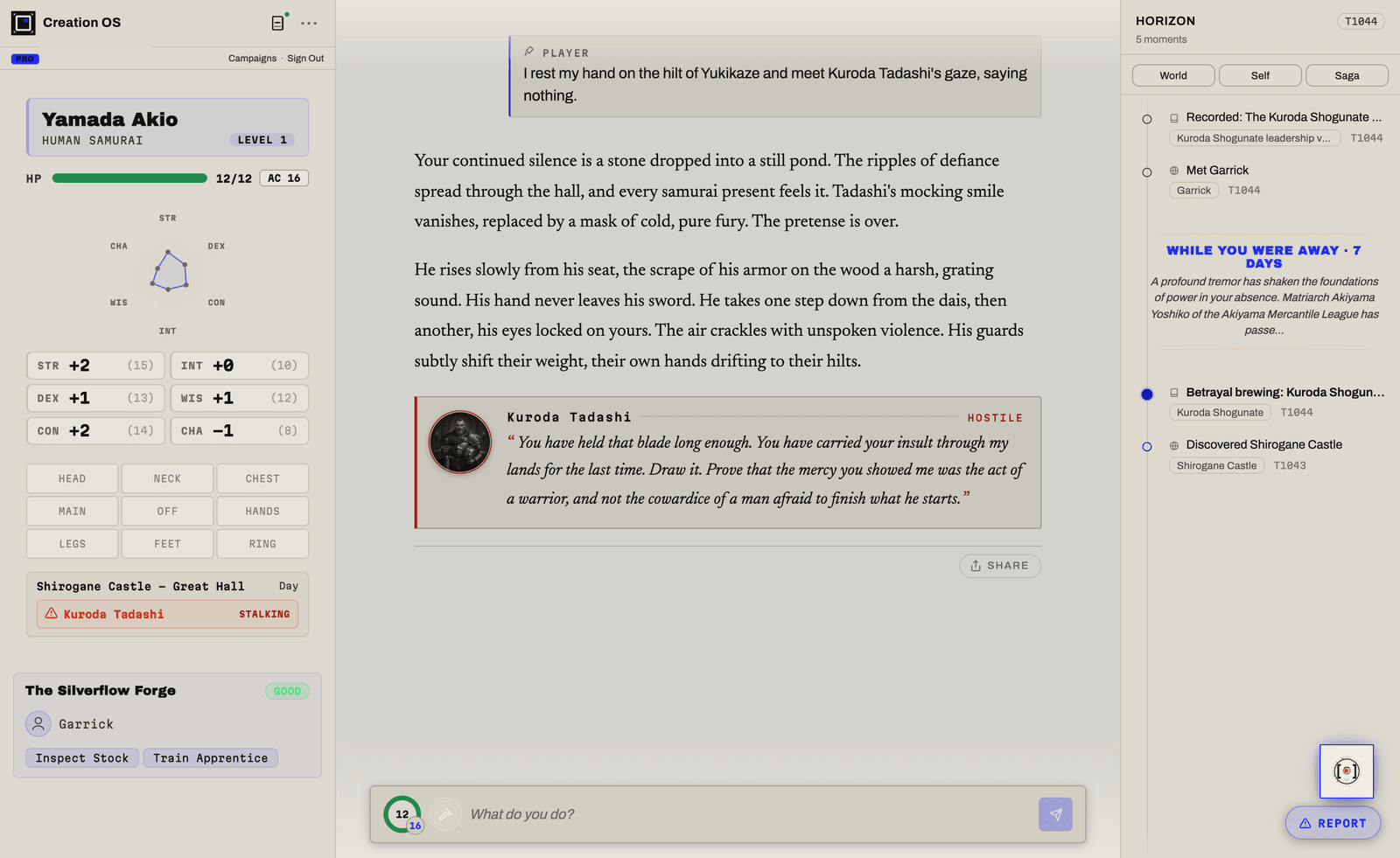
This is a real session, not a mockup. Your character, the world's memory, and a rival you wronged, all on one screen.

// 01 · WHERE THE WORLD SAYS NO
TRANSCRIPT-ONLY BASELINE
If a roleplay relies only on the active transcript, an invented item can be accepted because no separate inventory rejects it. Serious products address this with memory, authored lore, retrieval, rules, or structured campaign state. The useful question is which facts are stored outside the prose and which actions those systems can enforce.
CREATION OS®
Creation OS keeps supported inventory, prices, relationships, history, and mechanics as world state outside the narration. The Narrator receives that state before writing, and the system can refuse actions that conflict with what is already true.
That refusal is the whole point.
Ask for a sword you never picked up. The world checks. No sword.
Try to befriend a stranger the moment you meet her. Not yet.
Make a promise on day seven. The record can surface it later.
Close the tab on Tuesday. The world catches you up when you return.
// WE WON'T SAY EXACTLY HOW IT WORKS. THE COMPETITION IS STILL FIGURING IT OUT.
// THE WORLD REMEMBERS
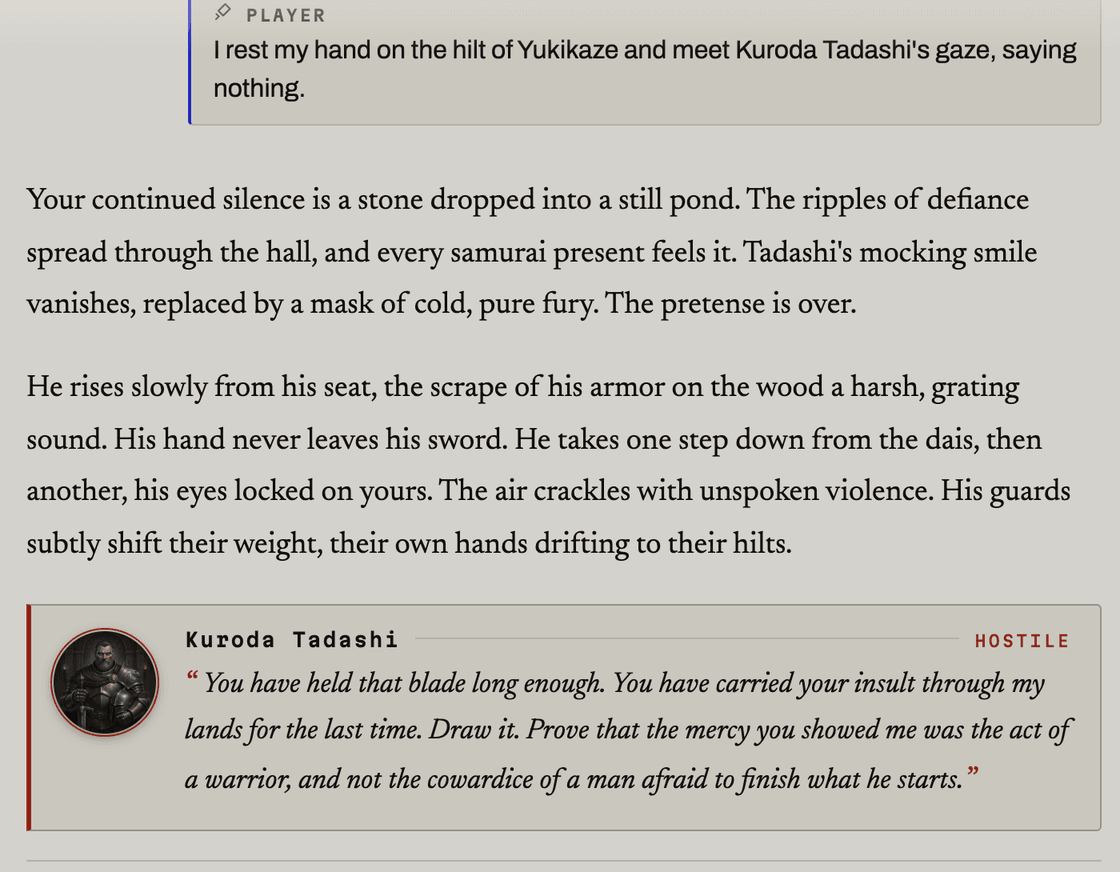
A rival you beat and let live, a thousand turns ago. You say nothing about the past. He brings it up anyway, because the world kept the grudge, not the AI's memory of the chat.

// 02 · WHAT YOU KEEP
Supported character history and relationships stay in the world record, so an apprentice can remain the same person later in the campaign.
Coins go in real infrastructure, not a sentence the AI might forget. Inventory, prices, debts, harvests. The math survives the months.
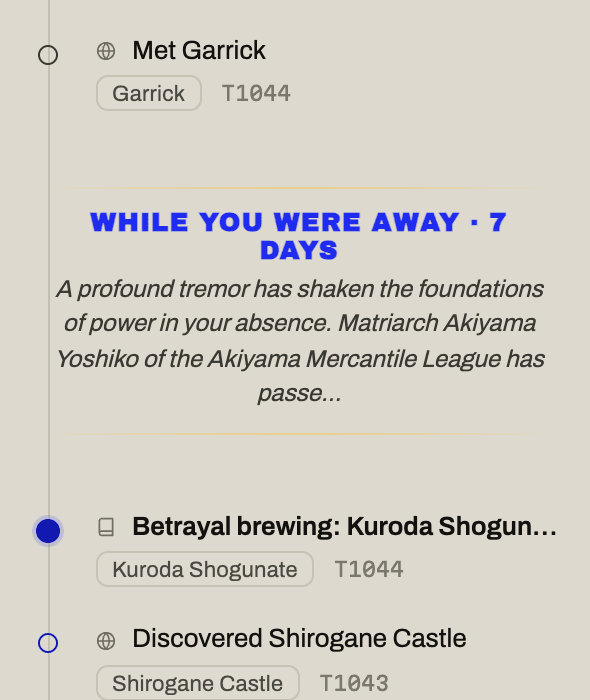
Close the tab and the scene holds. When you return, catch-up can resolve elapsed time for supported production already in motion and brief you on relevant changes.
The same core world-state model supports noir, fantasy, horror, science fiction, investigation, and quieter settings.

CLOSE THE TAB. THE WORLD CATCHES UP WITHOUT YOU.
// MORE IN THE BOX
Not ready to sign up? Meet a living character free, no account needed.
// 03 · A REAL TURN
One example, pulled from a long-running playtest. The ledger is real. The apprentice remembers.
The bread is rising. Mira asks if you'll teach her the rye loaf today, the one with the caraway, that her mother used to make.
An old man left an extra coin. He didn't say why. The engine logged it; ask him next visit.
// 04 · PRICING, PLAIN
Most players spend nothing for a while, then buy a small spark pack when they want more. Pro is for authors running several worlds or turning a played campaign into a Tome. Both are optional.
New accounts include 200 spark. Your first world is on the house.
Per turn. A flat rate, no matter how large your world grows.
Spark packs when you want more. Buy what you need, stop when you're done.
Pro, for authors running multiple worlds and binding campaigns into Tomes. Includes 1,500 spark and up to 12 new Tome chapters each billing cycle, plus priority engine access.
If a price tag chases you off, this probably wasn't your kind of thing.
// 05 · STRAIGHT ANSWERS
Yes. Shared Worlds lets up to six of you share one living world, each with your own character and your own ledger, playing on your own schedule. The world holds between everyone's turns. It is one shared world, not one shared chat window.
How Shared Worlds work ▶Yes, and it runs on real rules. Own property, hire workers, queue production, set prices, and trade with merchants who keep their own agendas. Supply routes can be cut and rivals can undercut you. When you return, supported production already in motion can resolve elapsed time under the normal rules. There is a colony mode and a survivor mode for when the stakes climb.
Yes. Own or build a smithy and you can put a blacksmith to work: feed in materials, queue the piece, and hire hands to lift your output. Forge blades and armor, brew remedies, mill grain, whatever your operation is set up for. What comes off the bench is real gear that goes straight into the world, and its quality rides on your smith, your materials, and the recipe you use.
Items added to your inventory are tracked as world state. A named blade can remain the same blade later, and supported actions such as picking it up, selling it, equipping it, or handing it to a friend update the record.
Yes. Run several properties in parallel, each with its own workers, stock, and books. Feed one operation from another, set up supply routes, and watch a market swing or a rival move ripple across all of it. Push far enough and a colony mode lets you run a whole settlement.
Creation OS supports fantasy, science fiction, historical, grounded modern, horror, investigation, naval, survival, football, and quieter character-led settings. Unusual concepts can still need a correction as the world takes shape.
Supported state such as inventory, money, relationships, properties, and event history carries across sessions. The Narrator can still phrase a detail loosely or need a correction. For evidence, one published world reached turn 5,011 and its event record is open to inspect.
Inspect the record ▶Tracked relationships and established facts can shape later scenes. A spared rival may carry that history, and a broken promise can return as a consequence. The Narrator can still need a correction on smaller details.
The scene holds while you are away. When you return, catch-up can resolve elapsed time and systems already in motion. A short briefing shows the relevant changes before play continues.
The World Record provides a pageable event timeline. Major debts, deals, victories, and betrayals can remain available for later scenes and for you to review.
There is real risk. Fights, heists, and gambles carry stakes and can go badly. Your preparation and your standing tilt the odds, but the world can still tell you no, and it remembers how it turned out.
AI roleplay services take different approaches to memory and mechanics. Creation OS keeps supported facts such as money, inventory, relationships, properties, and match results as world state. That lets it refuse some actions that conflict with what is already true.
You can meet a living character in your browser right now, with no account. When new accounts are open, your first built world is on the house. After that, spark packs start at $2.99 when you want more, and Pro is $14.99 a month for people running several worlds at once. It all runs in the browser, on your phone or your desktop.
Try the free demo ▶// YOUR TURN
The world holds. The ledger keeps. The apprentice will remember the loaf you taught her.