// THE PREMISE
What this world is
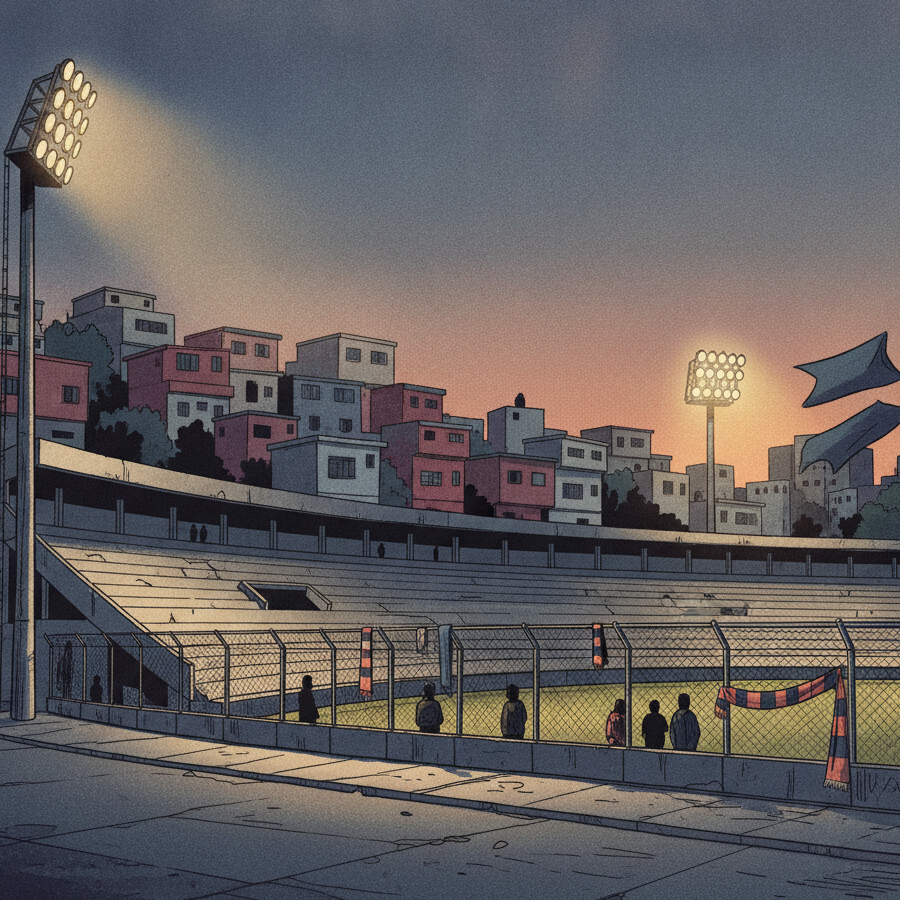
You are the new manager of Defensores de Villa Espinal, a fourth-tier club in a working barrio in the industrial south of greater Buenos Aires, where the asphalt gives out three blocks before the arroyo. The club is not a business. It is owned by its socios, more than four thousand member-owners who pay their monthly cuota whether or not there is meat in the freezer, because the day a family stops paying is the day the barrio knows things have gone wrong. It is also the barrio's true parliament: a whole city block of buffet and bochas courts and a swimming pool nobody can afford to fill. You were hired on Tuesday. The first match is Sunday, in the heavy summer heat of late February.
The squad is owed two months of wages. The tax office has an embargo on the gate, so match-day money officially does not exist, and if the arrears reach a third month the players' union frees every one of them for nothing. Into all of that, an election: the socios vote for a new president in five Sundays, and whoever wins owns your future. The honest old president has quietly mortgaged his own store to make payroll. His challenger offers clean money through a management company nobody can trace. The barra capo will offer you his loyalty early, publicly, and cheaply, and the cost will arrive later, itemised. And the club's one asset worth real money is a seventeen-year-old made on the potrero, whose grandmother holds the only vote that matters over his future.
You manage the way the barrio expects, face to face, one mate at a time: a captain who has not decided about you, a scapegoated keeper, an assistant who warned you not to come. A Sunday result is only one part of the job. There are wages to argue over, member-owners to answer to, and a young player's future at the centre of the election. Win on Sunday, keep the kid, survive the vote. What are you willing to trade to do all three?
// PLAY PROFILE
What this world plays like
Your first match is Sunday, but first comes the room. Talk with the captain and assistant, meet the people on the terrace, and decide whose public handshake you want. The club election is five Sundays away in the story, and the barrio wants to know what you stand for.
The young player's future connects the unpaid squad, the grandmother, the agent and the presidential candidates. You could argue for keeping him, seek a deal that buys the club time, or challenge what each faction says the club needs. Take the question back to the people who pay their cuota.
Build the story around the election, a promotion push, or the relationship between the team and its neighbourhood. Winning a match can give you a new conversation to have on Monday. It does not settle every question facing Villa Espinal.
// FACTIONS IN MOTION
Principal factions
The incumbent administration of the Defensores de Villa Espinal football club. Led by the traditionalist president, they represent the belief that the club is a social institution for the barrio, not a business. Their primary goals are to survive the upcoming election and manage the club's crippling debt without selling its soul.
The opposition slate in the club elections, led by a wealthy outsider. They advocate for a modern, business-first approach to save the club from bankruptcy, proposing corporate sponsorships and professional management. Their goal is to win the election and implement a sweeping, and controversial, modernization of the club's finances and structure.
The club's powerful and violent 'barra brava' (hooligan firm). They function as the keepers of the club's passionate faith but are also an economic entity, controlling all informal commerce around the stadium. Their goal is to maintain their territorial and financial power, exerting influence over both the team and the club's political leadership through support and intimidation.
The first-team players of Defensores de Villa Espinal. They are the club's most valuable and volatile asset, a fragile union of professionals whose careers depend on the club's ability to pay their wages. Their primary goals are to get paid, win games to secure better contracts elsewhere, and navigate the immense pressure from the board and the barra.
// KEY FIGURES
People you'll meet
// SITES OF RECORD
Places that matter
A full city block housing the club's soul. The front buffet serves cheap coffee and strong opinions. Deeper in are the yellowed linoleum of the main salon and the clay bochas courts where old men who have seen fifty técnicos come and go hold the real club debates.
The club's concrete fortress, named for the meatpacking plant its founders worked at. One covered main stand, three open concrete terraces. The immaculate pitch, 'el Vasco's miracle', is the only perfect thing in Villa Espinal.
The main artery of Villa Espinal, where the last of the asphalt is. It's lined with small businesses: Cacho's hardware store, a bakery, a butcher, and Lo de Tita, the cafe where the barrio's verdict on the Sunday game is handed down over coffee.
A patch of hard-packed dirt and patchy grass behind the old, rusting gasworks. The goals are two piles of bricks. This is where football is not a job but a game, the barrio's true academy.
The concrete bridge over the arroyo that marks the edge of Villa Espinal. Across it, the roads are better maintained, the houses have gardens, and the home of the derby rival sits, a club with more money and less history.
// STORY PASSAGE
A passage from the published profile
Just four minutes in, a sharp break down the right. Iker Roldán threads a perfect pass into the box, and Santiago Castillo, ghosting in late, unleashes a low drive that nestles in the corner. La Caldera explodes, a visceral wave of sound and joy. Defensores leads 1-0!
Selected story passage. Your choices can lead elsewhere.
BEFORE YOU ENTER
Choose a first decision
Start with a person you want to meet, a place you want to see, or a problem you want to understand. You make choices through written actions and read the Narrator's response. The people and places above introduce this world; they do not promise a fixed sequence of scenes.
Completed turns save to your account. Review the latest scene and the relevant in-game information when returning. Check current access and Spark allowances before a longer session, and use the player guide for help with saves, artwork, possessions, and other supported features.
Profile updated .
CHECK ACCESS AND SPARK COSTS · CHOOSE A CHARACTER BEFORE PLAY