// THE PREMISE
What this world is
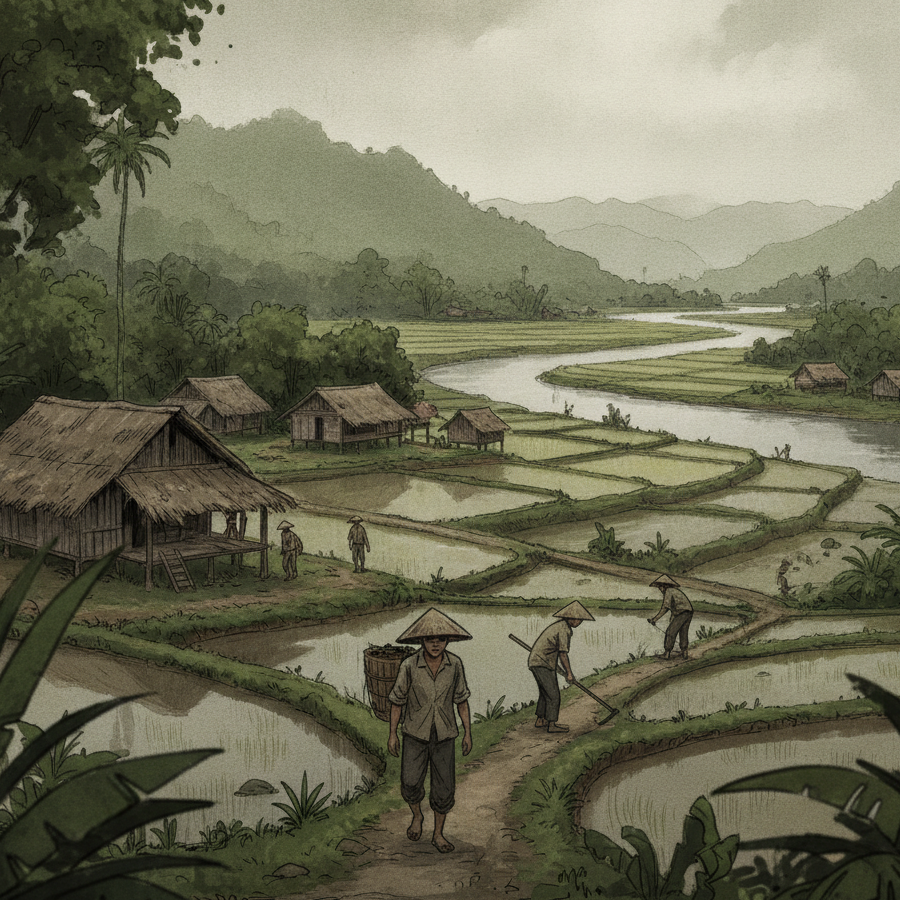
Phù Sa is a village of nine hundred people on the north bank of the Thu Bồn river in Quảng Nam province, central Vietnam. It is late April, 1968. The offensive at the Lunar New Year is three months past, and out here in the river country the war has settled back into its daily arithmetic. An American patrol comes through by day. The Front comes at night. The rice stands green and heavy in the paddies, three weeks from harvest, and everyone with a rifle within ten kilometres intends to have a say in where it goes.
The village lives under two governments. By day the Saigon flag flies over the school and the militia holds the bridge; by night the flag comes down in every mind watching the treeline, and the cadre collects the rice tax and leaves receipts as dangerous to keep as to refuse. Every family holds papers from both sides, and either set, found by the wrong visitor, can be fatal.
You enter at an angle of your choosing. A villager with rice, family, and debts at stake. A conscript at the bridge, holding a rifle between his own family and his own government. An American rifleman or medic rotating through on patrol. A relief worker up from the district town. Or a correspondent chasing a story that is not a body count. The world does not hand you a side. It hands you a village where every word travels.
No side here is clean, and everyone arrives with reasons. The great decisions are made far away, by men who will never learn the village's name. The decisions close enough to touch are small and personal: who you warn, who you feed, what you write down, what you burn, and which name you give up when a man with a list finally asks. Keep the story close to the people who must live with what those choices cost.
// PLAY PROFILE
What this world plays like
Choose your place in Phù Sa before choosing an objective. A villager, a conscript, a visiting medic, an aid worker, and a correspondent see the same bridge and rice fields from different positions.
Begin with a conversation or a practical need. Learn which households are under pressure, what a patrol is asking for, and what can safely be put on paper. Decide whose account you trust without assuming that any uniform tells you the whole story.
The harvest and the village's future offer possible longer threads. You could focus on helping a family, caring for the wounded, reporting what you see, or deciding how to answer when someone asks for a name. Keep your first aim small enough to concern a person, rather than treating the village as a problem to solve from above.
// FACTIONS IN MOTION
Principal factions
The traditional authority of Phù Sa, embodying the village's Confucian and ancestral beliefs. Led by the elders, the Council seeks to maintain social harmony, mediate disputes according to custom, and protect the village's spiritual and physical well-being by navigating the lethal demands of the warring factions. Their power is moral, not military, and is rapidly eroding.
The local arm of the Government of Vietnam (GVN), tasked with securing the vital bridge into Phù Sa and denying access to the NLF. Comprised of local men, the platoon is caught between duty to a distant government and kinship with the villagers they police. They are poorly equipped but possess intimate knowledge of the terrain and people.
A pragmatic and ruthless black market network that thrives on the war's scarcities. Led by the shrewd Bà Sáu Lụa, they smuggle essential goods like medicine and batteries from Đà Nẵng, as well as American luxuries, selling to villagers, GVN soldiers, and NLF cadres alike. Their currency is not ideology but rice, gold, and information.
An American airborne infantry platoon operating from a nearby fire support base. Possessing immense firepower but little understanding of the local culture or politics, they conduct patrols through Phù Sa to 'find and fix' the enemy. To the villagers, they are a source of both terrifying violence and coveted C-ration goods.
The local revolutionary cell dedicated to overthrowing the GVN and expelling the Americans. Operating from the shadows within the village and the nearby hills, they collect a rice tax, gather intelligence, and dispense brutal justice against 'collaborators'. They represent an alternate, clandestine power structure built on ideology, fear, and promises of reunification.
// KEY FIGURES
People you'll meet
// SITES OF RECORD
Places that matter
A small cluster of houses and sampans by the riverbank, downstream from the main ford. The air smells of fish, shrimp paste, and damp nets. The people here live by the river's rhythms.
A small, grim fortification of sandbags, tin sheeting, and barbed wire at the village's main bridge. It represents the tenuous, daylight-only reach of the Saigon government.
A low, scrub-covered hill overlooking the village and the river valley, crowned by the crumbling ruins of a French-era watchtower. It offers a commanding view of every path and paddy.
An unseen American artillery base located several kilometers away, over the ridgeline. Its existence is known not by sight, but by the percussive thump of its guns firing and the scream of shells overhead.
The seat of the district government, a place of offices, paperwork, and official authority. It is relatively safe, surrounded by wire and checkpoints, a world away from the realities of village life.
The heart of the village, clustered around the market ford, the schoolhouse, and the half-ruined đình. This is where news arrives first and where most public interactions, watched and unwatched, take place.
// STORY PASSAGE
A passage from the published profile
Following the faint scent of jasmine incense, you soon reach the Phù Sa Pagoda, a small, elegant structure nestled amidst a grove of bamboo. The chanting grows clearer here, a low, steady drone that feels like a balm after the tension of the checkpoint. Inside, the air is cooler, filled with the scent of old wood and the quiet presence of ancestors. Thầy Thích Quang Minh, the venerable monk, sits cross-legged before a small altar, his eyes closed in meditation, a faint smile playing on his lips.
Selected story passage. Your choices can lead elsewhere.
BEFORE YOU ENTER
Choose a first decision
Start with a person you want to meet, a place you want to see, or a problem you want to understand. You make choices through written actions and read the Narrator's response. The people and places above introduce this world; they do not promise a fixed sequence of scenes.
Completed turns save to your account. Review the latest scene and the relevant in-game information when returning. Check current access and Spark allowances before a longer session, and use the player guide for help with saves, artwork, possessions, and other supported features.
Profile updated .
CHECK ACCESS AND SPARK COSTS · CHOOSE A CHARACTER BEFORE PLAY