// THE PREMISE
What this world is
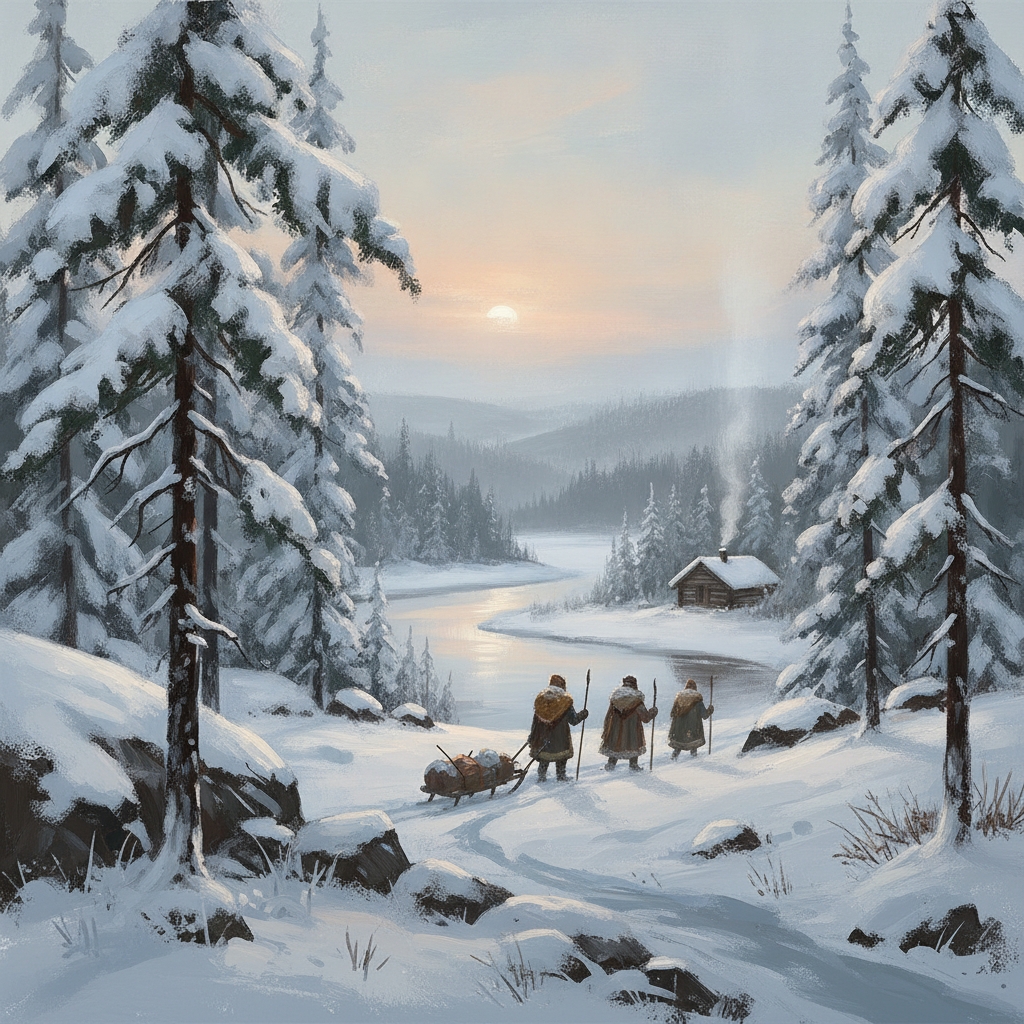
Koivisto is a Karelian village of thirty-eight souls on the shore of Lake Vakka, in February of 1912. The lake has not frozen. It should have frozen in November. It is now the fourteenth of February, the air is minus thirty, and the lake is still liquid, still steaming.
The pastor died on the twenty-third of January. His widow knows why. His replacement has not left the parsonage since the day he arrived. The villagers do not say his name aloud. The Rautio store is open. The cooperative still meets. The men of the upper river still come down for salt and tobacco. None of it is normal anymore, but Koivisto goes on doing what Koivisto has always done, because the alternative is unthinkable.
You arrive into a village that is keeping a secret from itself. Aino Virtanen will tell you nothing the first time you ask. The Yläjoki loggers stopped coming down a week ago and nobody has gone to check. Tobias Lindqvist's daughter sleepwalks now. The lake at dusk makes a sound that resembles a hymn one note out of true.
This is a horror sandbox. You can leave on the Sortavala Road. The road is a long walk in winter. The lake is closer.
// PLAY PROFILE
What this world plays like
Your first ten turns introduce you to the village by name. The pastor's widow weighs you. The Rautio store treats you as a customer until they decide whether to treat you as something else. You may sit in the church. You may walk the shore. The lake does not warm under any conditions you can identify, and the village's quiet refusal to discuss this is the first thing you notice.
By turn fifty, you have a bedroom somewhere and a place at someone's table. You have heard one story you wish you hadn't. The replacement pastor has spoken to you, or refused to. The Yläjoki loggers' camp is silent. The lake has crept inland by a measurable distance, which is impossible.
By turn one hundred, the village is dividing along lines that did not exist when you arrived. The Väen Voima are arming. The church faction prays differently than they did a week ago. The Järven Kansa have stopped coming to market. Whatever is happening to Koivisto is now happening to you, and the world remembers each choice you have made, including the ones you regret.
Koivisto does not reset between sessions. Close the tab on Tuesday. The lake does not freeze.
// FACTIONS IN MOTION
Principal factions
An informal but powerful coalition centered on the Virtanen family, dedicated to preserving the old Karelian traditions and social order. They believe the unfrozen lake is a sign of imbalance that can only be corrected by the 'practice', a pre-Christian sacrificial rite. Their goal is to ensure the rite is performed to save Koivisto from starvation, regardless of the moral or religious cost.
The official religious authority of the village, representing the Evangelical Lutheran state church. Led by the new, outsider pastor, this faction seeks to impose a strict, scripture-based faith and eradicate the local syncretic traditions which it views as pagan heresy. They interpret the village's hardship as a divine punishment for its apostasy.
The economic heart of Koivisto, run by the pragmatic Henrik Rautio, who controls the only flow of goods and information from the outside world. This faction is driven by profit and the maintenance of its monopoly, not by faith or tradition. Their primary goal is to see stability returned, as a starving village cannot produce the surpluses needed for trade.
A loose-knit group of younger men, primarily loggers, who reject the old superstitions that govern village life. They represent a more modern, rationalist worldview and believe the 'practice' is nothing more than ritual murder. They seek a practical solution to the famine, looking to organized hunting or an appeal to the authorities in Sortavala rather than appeasing a lake spirit.
The destitute families, led by the Korhonens, whose entire livelihood was destroyed when the lake failed to freeze. Utterly desperate, they are driven by the singular goal of survival. They are a volatile and unaligned group, easily swayed by promises of food or a swift return to normalcy, making them a key political pawn in the conflict between the other factions.
// KEY FIGURES
People you'll meet
// SITES OF RECORD
Places that matter
A line of eight red-painted log houses and a central store, set back from the lake and huddled against the encroaching forest. Woodsmoke hangs heavy in the frigid air, the only sign of the thirty-eight souls weathering the unnatural winter within.
A shoreline of dark, smooth stones, unnaturally warm to the touch. The lake itself is a black, liquid mirror, perpetually steaming into the minus-thirty-degree air. The column of steam is visible for kilometers, a slow, constant exhalation.
A low ridge overlooking the village and the lake, crowned by the white wooden church and the dark, two-story parsonage. The wind is sharper here, and the view of the lake's steaming expanse is total and unnerving.
A narrow track cut through forty kilometers of dense, snow-laden taiga forest, barely wide enough for a single sleigh. The trees press in close, their branches heavy with snow, muffling all sound. To be caught here at night is a death sentence.
A collection of crude timber barracks deep in the forest upstream from Koivisto, populated by transient lumberjacks. The air smells of pine resin, sweat, and cheap tobacco. It is a place of hard labor, hard drinking, and rough men.
// LIVE TURN
A real turn from this world
Aino sets the kettle down without looking at you. The kitchen is small enough that you can hear her breathing.
"My husband," she says, "wrote a letter on the twenty-second."
She does not say the twenty-third. She does not say what happened on the twenty-third.
The letter is on the table between you, folded twice, the wax broken. She has not opened it again since the funeral. She has not given it to the new pastor. She is giving it to you because you asked the right thing, or because she has decided you are who he meant.
You take the letter. You do not read it yet. The world records that you carry it. Aino's trust shifts +2. Standing with the church faction shifts -1. The replacement pastor, who watches the village from his window, will have noticed.
// WHY IT HOLDS UP
Why Koivisto - The Lake Unfrozen holds up over a long run
The factions, characters, and places on this page are live state the world tracks, not prose written once and forgotten. What you do changes them: what you own, who owes you, who has forgiven you and who has not.
Supported state persists between sessions. Leave for a week and the scene holds; come back and catch-up can resolve relevant elapsed changes. An established promise can remain available for a later consequence, though the Narrator may still phrase a smaller detail loosely.
FREE TO START · QUICK-START OR AUTHOR YOUR OWN CHARACTER NEXT