// THE PREMISE
What this world is
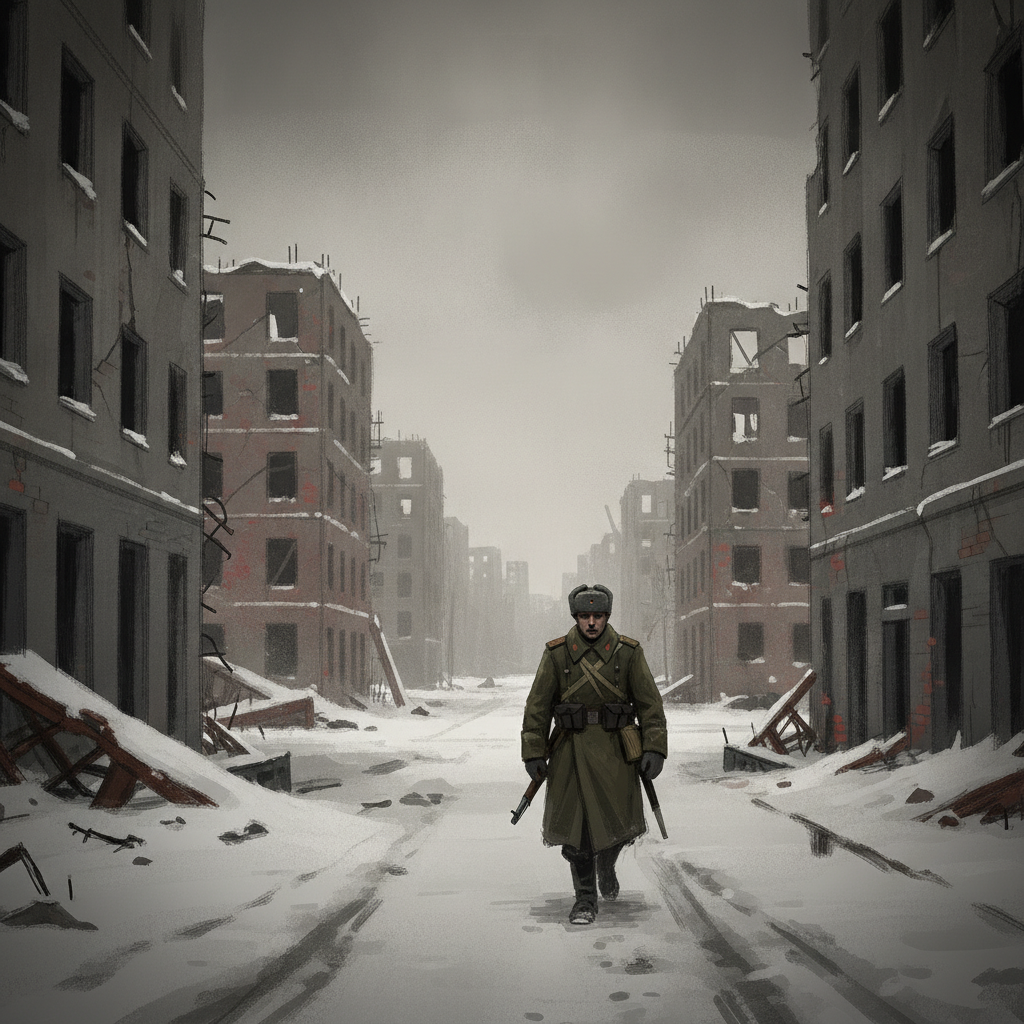
Leningrad, late January 1942. The city has been surrounded since September, and the only way in or out is the ice road across Lake Ladoga, where trucks cross at night with their headlights off. The war does not arrive here as battles. It sits over the city like weather: shelling in the morning when the bread queues form, and under everything the cold and the hunger, which kill more people every day than the guns do. Bread is life, and every gram of it passes through human hands: the warden who keeps the ledger of the living and the dead, the manager who weighs the ration honest to the gram, the clerk who moves the sacks, the driver who hauls flour across the ice.
You enter as anyone the city holds: a soldier on the frozen rim of the front, a doctor in a ward where the ink freezes, a teenage firewatcher running messages across the rooftops, a lathe hand in a factory that never stopped, a correspondent with two notebooks, or simply a neighbour in House 14 trying to keep a family alive until the thaw.
The world hands you no uniform and no script, only one winter. What is decided on your street is smaller and harder than whether the city falls: what a person costs. Who you feed, who you report, who you carry, and what it costs you, in a city where kindness is weighed out in grams like everything else. Your story stays close to those people and the difficult choices within reach of your street.
// PLAY PROFILE
What this world plays like
Begin close to one street: a bread queue, a water hole in the ice, a stairwell where a stove has gone cold. Choose a role and learn the people who depend on your work. A ration or a letter can be the centre of a session.
You could follow an ice-road delivery, work in an unheated ward, or try to secure an evacuation place for someone in House 14. What would you share, whom would you carry, and what would you ask another person to risk?
Keep the story at the scale of those relationships. In this historical fiction, the people of House 14 give the wider siege a human scale. Bring a letter, a ration or an unfinished promise back to their door.
// FACTIONS IN MOTION
Principal factions
A scattered, uneasy web of black-market traders and desperate opportunists who have made Sennaya Square the heart of illicit barter. There is no boss and no order to them, only people trading stolen ration cards, hoarded food, and the last valuables of the dying for a few more days of survival. To the state they are parasites; to many starving citizens, they are the only source of food outside the official channels.
A clandestine group of Orthodox believers centered around the staff and patients of Hospital No. 87. Led by a former priest now working as an orderly, they offer whispered prayers, last rites, and a sliver of spiritual comfort in defiance of state atheism. Their faith drives them to acts of profound charity, sharing what little they have and maintaining a moral code in a world that has abandoned it.
The exhausted but determined soldiers of the Red Army holding a critical section of the front line. Their existence is a cycle of shelling, frostbite, and dwindling ammunition. They are focused on the external enemy but are slowly being ground down by starvation and the cold from within.
The drivers and mechanics of the GAZ-AA trucks that are the city's lifeline. They brave constant German artillery, air raids, and the cracking ice of Lake Ladoga to deliver food and evacuate civilians. Hailed as heroes, they are also under immense pressure, and some are tempted by the black market to smuggle goods for their own survival.
The state's iron fist within the besieged city. Tasked with crushing dissent, hunting spies, and prosecuting economic crimes like hoarding and speculation. They operate with near-total authority, instilling fear and ensuring the Party's will is obeyed, even at the cost of humanity.
// KEY FIGURES
People you'll meet
// SITES OF RECORD
Places that matter
A static, frozen line of trenches, bunkers, and barbed wire dug into the southern outskirts of the city. The landscape is a monochrome chaos of shell craters, shattered trees, and the ruins of suburban dachas. The war here is one of attrition, sniper fire, and sudden, brutal raids.
A complex of brick buildings with blacked-out windows, surrounded by workers' barracks. The air smells of metal and coal smoke. Inside, weakened workers like Yelena Voronina operate lathes and presses for eleven hours a day, turning out shell casings and military hardware.
A former school building, its hallways and classrooms converted into wards. The air is frigid and carries the smell of antiseptic and gangrene. Windows are boarded or sandbagged, and the only heat comes from a few burzhuika stoves that are never enough.
Four blocks of old, four-story apartment houses built around courtyards, their classical facades stained with smoke. The street is a microcosm of the city's suffering, a community bound by proximity and suspicion, where every closed door hides a family's private arithmetic of survival.
A wide, wind-swept square, once a bustling market, now a desperate nexus of barter. People wrapped in rags stand silently, offering a single item for sale: a book, a clock, a pair of child's shoes. It is the city's open secret, a place of last resorts.
A 30-kilometer track across the frozen surface of Lake Ladoga, marked by frozen telephone poles. At night, it's a terrifying void of white darkness, where truck convoys move without headlights, guided by traffic controllers standing in the freezing wind. By day, it is exposed to German artillery and air attack.
// STORY PASSAGE
A passage from the published profile
The bread queue is a silent testament to the city's hunger. It snakes around the corner of a bombed-out building, a line of huddled, bundled figures, each face gaunt and etched with the same weary resignation. The air is still biting cold, but here, in the close proximity of so many bodies, there's a faint, humid scent of unwashed wool and starved desperation. You shuffle forward with the rest, the only sound the soft crunch of snow underfoot and the occasional, rasping cough. At the head of the line, a stern-faced woman in a thick coat meticulously slices a gray, dense loaf, more cellulose and sawdust than flour, by the smell of it. Each meager portion is placed on a small, rusted scale, then slid across the counter with a curt nod, or a shake of the head if the ration card is invalid or used. The process is painfully slow, a ritual of scarcity.
Selected story passage. Your choices can lead elsewhere.
BEFORE YOU ENTER
Choose a first decision
Start with a person you want to meet, a place you want to see, or a problem you want to understand. You make choices through written actions and read the Narrator's response. The people and places above introduce this world; they do not promise a fixed sequence of scenes.
Completed turns save to your account. Review the latest scene and the relevant in-game information when returning. Check current access and Spark allowances before a longer session, and use the player guide for help with saves, artwork, possessions, and other supported features.
Profile updated .
CHECK ACCESS AND SPARK COSTS · CHOOSE A CHARACTER BEFORE PLAY