// THE PREMISE
What this world is
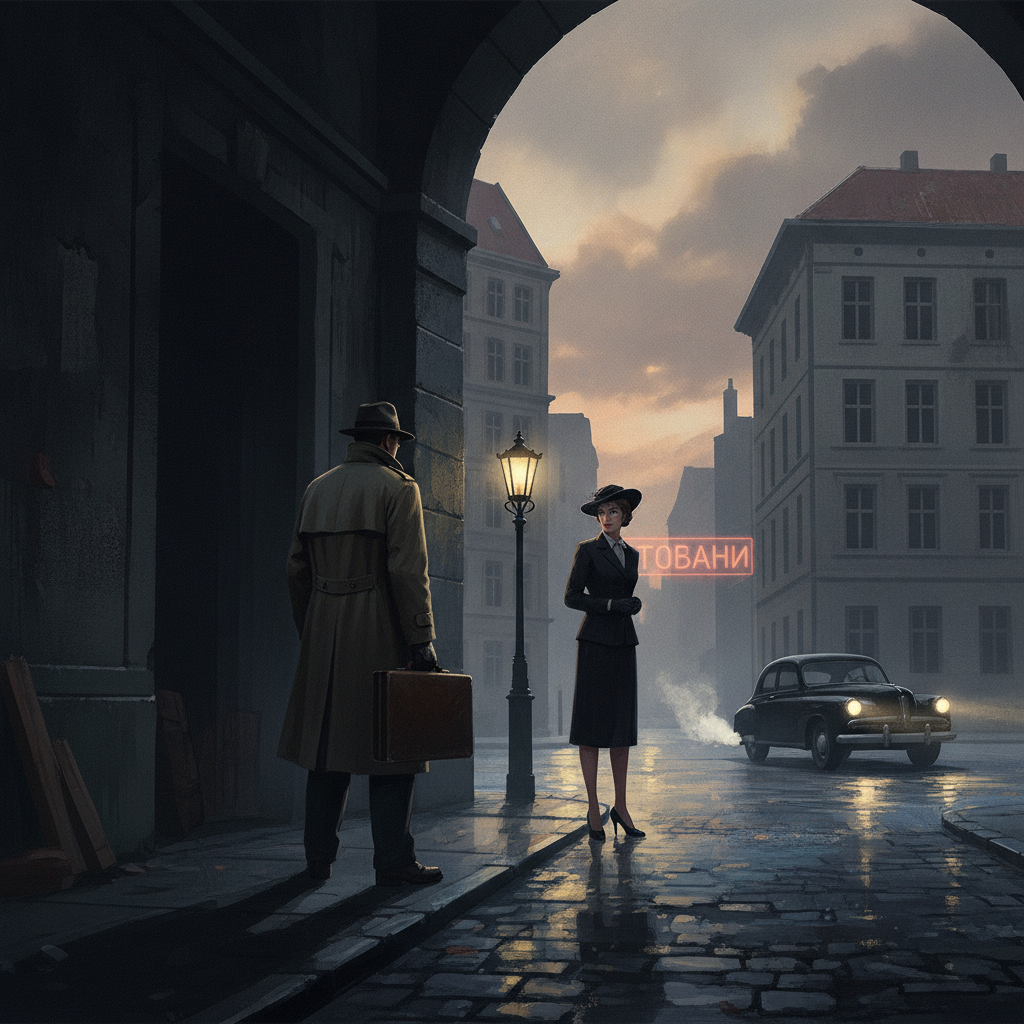
Berlin, the autumn of 1961, weeks after the Wall went up: the most dangerous city on earth, split down the middle, where every doorway might hide a watcher. You are an intelligence officer - or an agent who can pass as one - working a divided city where the great powers' spy services fight a silent war of dead drops, double agents, and quiet murders that never make the papers. You arrive with a cover identity, a handler, and a mission that is about to go very wrong, because someone in your own service is selling you out.
This is a thriller of tradecraft and paranoia: surveillance and counter-surveillance, recruiting and running agents, working sources, and never being sure who across the table is what they claim. Colonel Erich Vogel's Stasi Hauptabteilung II runs an informant web so deep that half the city reports to him without knowing it. The CIA's Berlin Operations Base works the American sector. Major Anatoly Volkov's KGB Residency at Karlshorst are the true masters of the East and would rather turn you than kill you. Klaus Brandt's apolitical smuggling network treats the Wall as a business opportunity and sells to all sides. And Pastor Johanna Schmidt's Marienkirche Confessional Circle hides dissidents and the desperate trying to reach the West.
Trust is the only currency and it is always counterfeit. A list of Western agents in the East is about to be blown, the Stasi are rolling up the network, and the Wall has trapped sources and families on the wrong side. Run your tradecraft, work your sources, find the mole before the mole finds you, and decide where your loyalty actually lies - to a service that would burn you, to the people caught in the machine, or to yourself.
// PLAY PROFILE
What this world plays like
Establish your cover, make contact, and decide whether the first source is too useful to trust. Checkpoint Charlie, a dead drop, or a drink at the Blaue Stunde can put you in view of people whose interest is difficult to shake.
Work between Vogel's Stasi, the CIA base, Volkov's KGB Residency, and Klaus Brandt's smugglers. Pastor Schmidt's circle shelters people whose lives cannot wait for the intelligence services to settle their accounts. A favour from Brandt may be useful long before it is comfortable.
Find the mole, protect a source, or arrange a crossing before the network burns. You can put your service first, side with the people trapped by the Wall, or seek your own escape. A clean way out may cost the person who helped you find it.
// FACTIONS IN MOTION
Principal factions
The sword and shield of the Socialist Unity Party, the Ministry for State Security's counter-espionage division is obsessed with ideological purity and internal security. They hunt Western spies, political dissidents, and would-be escapees with methodical, bureaucratic cruelty. Their presence is an invisible, suffocating weight on all of East Berlin.
Operating from the American Sector, the CIA's Berlin station is the tip of the spear in the Cold War. They run a web of agents and informants in the East to gather intelligence on Soviet military and political intentions. They are currently haunted by the suspicion of a high-level mole, codenamed 'PERSEUS', who is systematically compromising their operations.
An apolitical smuggling ring that profits from the city's division. Led by the cynical but pragmatic Klaus Brandt, they move anything and anyone across the Wall for the right price: Western cigarettes, nylon stockings, desperate families. They navigate the treacherous space between the great powers, trusting only hard currency.
A clandestine group operating within the historic St. Mary's Church, motivated by Christian conscience rather than political ideology. Led by Pastor Dietrich Schmidt, they provide sanctuary and aid to those persecuted by the state. They use their religious cover and a network of parish houses to help people escape, viewing it as a moral imperative.
The true masters of East Berlin, the KGB Residency views the Stasi as a useful but junior partner. Their primary concerns are strategic: hunting the mole 'PERSEUS', stealing NATO military plans, and ensuring the absolute loyalty of their German satellite. They operate with a quiet, lethal authority that even Stasi colonels fear.
// KEY FIGURES
People you'll meet
// SITES OF RECORD
Places that matter
A smoky, dimly lit bar owned by the fixer Klaus Brandt. The jazz on the record player is mournful, the beer is cold, and the whiskey is real. It is one of the few places in Berlin where agents from all sides can meet, albeit cautiously.
A vast, intimidating complex of grey concrete buildings in East Berlin, surrounded by fences and watchtowers. This is the heart of the Ministry for State Security, housing offices, technical labs, archives, and the infamous Hohenschönhausen remand prison.
An elegant West Berlin coffeehouse with large windows, serving strudel and strong coffee. It's a favored, unofficial meeting spot for the Firm's officers, who use its relaxed atmosphere to project an air of confidence they do not feel.
A wide, barren scar running through the city's heart. It consists of the primary concrete wall, a raked gravel field to show footprints, anti-tank obstacles, and a secondary fence, all overseen by floodlights and watchtowers with orders to shoot to kill.
The sprawling Tiergarten park is still dotted with the ruins of WWII. A specific one, the half-collapsed nave of a bombed-out church, serves as a major dead drop. Its crumbling walls and overgrown cistern provide countless hiding spots.
The most famous crossing point between East and West, reserved for Allied personnel and foreigners. A small wooden shack in the middle of a wide, barren street, watched by American MPs on one side and East German Grenztruppen on the other. The air is thick with tension and the smell of diesel fumes.
// STORY PASSAGE
A passage from the published profile
Klaus Brandt slides the envelope back across the bar, untouched. "I move people, cigarettes, and secrets, and I do not care whose flag is on them," he says, the cynicism worn smooth as a coin. "But you, my friend, are radioactive. Vogel's people asked about you on Tuesday. The Americans asked on Wednesday. When two sides ask about the same man in one week, that man is being set up by a third." He lights a cigarette. "I like you. So I am telling you for free, this once."
He is the only honest liar in Berlin, and that is exactly why you believe him.
Selected story passage. Your choices can lead elsewhere.
BEFORE YOU ENTER
Choose a first decision
Start with a person you want to meet, a place you want to see, or a problem you want to understand. You make choices through written actions and read the Narrator's response. The people and places above introduce this world; they do not promise a fixed sequence of scenes.
Completed turns save to your account. Review the latest scene and the relevant in-game information when returning. Check current access and Spark allowances before a longer session, and use the player guide for help with saves, artwork, possessions, and other supported features.
Profile updated .
CHECK ACCESS AND SPARK COSTS · CHOOSE A CHARACTER BEFORE PLAY