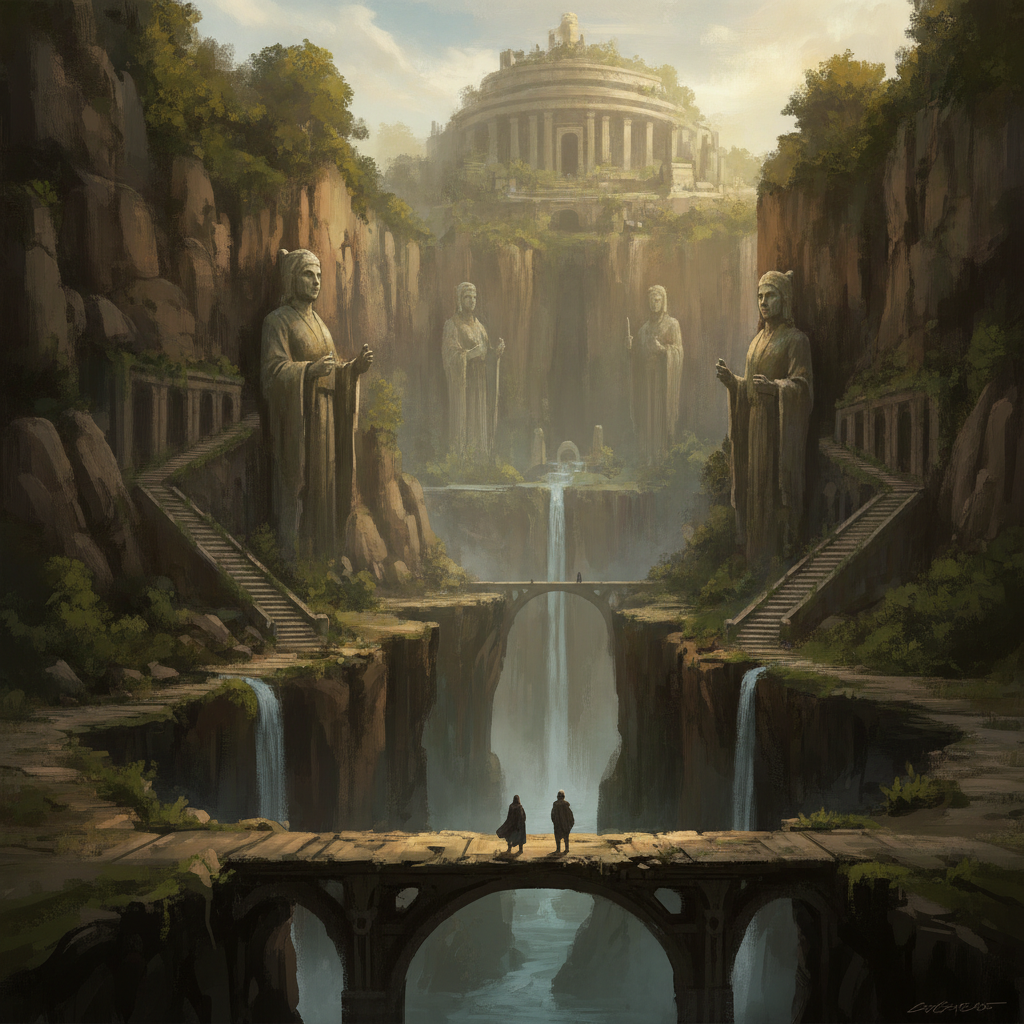
// THE PREMISE
What this world is
The Levant in this campaign is the Levant of the early twelfth century, with the magic stripped out and the geopolitics turned up. The Principality of Antioch is run by Norman lords who are nobody's vassals. The County of Edessa is too far east and too thin to be properly defended. The Fatimid garrison at al-Quds holds the holiest road. The Byzantines watch from Cilicia and pretend they are not waiting. The Genoese sail under flags that mean different things in different harbours.
You start as anyone. A Catholic pilgrim who has just stepped off the boat. A Genoese merchant who knows three languages and which one to use. A Byzantine mercenary whose pay is months late. An Ascalonite trader whose family runs the cousins who run the docks. You arrive into a Levant that is not waiting for you.
The empire controls the main hubs. The mountains are full of old Crusader remnants and hidden sanctuaries. The Pilgrim's Road is the most travelled corridor on earth. The Princes' Council holds court in Antioch and the court is divided. The Legatine Council answers to Rome and not always quickly.
This is a historical sandbox. There is no magic. There are only roads, ledgers, faiths, oaths, and the people who keep them.
// PLAY PROFILE
What this world plays like
Your first ten turns will pass on the Pilgrim's Road or in Antakya, depending on where you started. You will meet a guide who lies for a living and a guide who does not. You will pay tariffs you did not budget for. You will hear the call to prayer and the sext bell on the same wind, and your guide will tell you which one is meant for you today.
By turn fifty, you have a coin pouch with three currencies and a letter of credit you have decided whether to honour. Standing with the four factions exists as a real number. You may have crossed into Edessa, where the County is grateful for any literate man with a horse. You may have stayed at the Genoese factor's house and made a deal that will not look like a deal until next year.
By turn one hundred, you have a name in at least two cities. The Princes' Council has a clerk who knows yours. The Fatimid garrison at the relevant gate has noticed your face. You may be brokering a hostage exchange. You may be quietly evangelising. You may be running a cargo route that crosses three sets of customs and a fourth that exists only on a wax tablet. The Levant remembers your debts.
The Levant does not reset between sessions. Close the tab on Tuesday. The road does not.
// FACTIONS IN MOTION
Principal factions
The high command of the First Crusade, a fractious council of the most powerful Frankish and Norman nobles. Publicly united by their vow to free the Holy Sepulchre, they are privately driven by deep-seated rivalries for prestige, land, and ultimate leadership of the expedition.
The hardened warriors and loyal retainers of Bohemond of Taranto. Having captured the great city of Antioch through cunning and bloodshed, they now prioritize consolidating their new principality over continuing the march to Jerusalem, defying their oaths to the Byzantine Emperor and the authority of the other Crusader princes.
The spiritual heart of the Crusade, representing the authority of Pope Urban II. Led by the Papal Legate, their purpose is to maintain the army's piety, mediate the princes' endless disputes, and ensure the expedition remains a holy pilgrimage, not a war of conquest. They hold immense moral authority, especially over the common soldiers.
A powerful fleet of warships and transports from the Republic of Genoa, driven by commerce rather than faith. They provide essential siege engineers, supplies, and naval blockades for the Crusaders in exchange for lucrative trade monopolies in any captured ports. Their captains are known to trade with anyone, even the Fatimids, if the price is right.
The professional army of the Fatimid Caliphate tasked with defending the holy city of Jerusalem, known to them as al-Quds. A well-equipped and diverse force of Arab and Sudanese soldiers under a determined governor, they command the city's formidable walls and are prepared to fight to the death to repel the Frankish invaders.
A clandestine network of Isma'ili devotees, known to their enemies as the Assassins. Operating in secret cells within the cities of Syria, they use infiltration and targeted murder to eliminate political figures, both Crusader and rival Muslim, who threaten their secretive agenda. Their existence is a whisper, their motives a mystery to outsiders.
// SITES OF RECORD
Places that matter
The first Crusader State, centered on the ancient city of Edessa east of the Euphrates. It is a dry, rolling landscape dotted with castles and Armenian monasteries. The Frankish ruling class is a tiny minority, relying on alliances with local Armenian nobles to survive.
The name given to the hazardous stretch of land between Antioch and the Fatimid-controlled coast, encompassing the Ghab valley and the northern Lebanese mountains. It is not a state, but a contested corridor of ruined villages, ambush-ready canyons, and desperate travelers.
The rich, fertile coastline from the port of Acre south to the fortress of Ascalon, the gateway to Egypt. This is the heart of Fatimid power in the Levant, dotted with wealthy cities, olive groves, and sugar cane fields, all heavily garrisoned by the professional Egyptian army.
The southern coast of Anatolia, a rugged land of mountains and small ports. It is technically Byzantine territory, governed by their Armenian vassals. It serves as the primary entry point and staging area for the Crusader armies arriving from Constantinople.
The ancient city of Antioch, a titanic fortress ringed by mountains and the Orontes river, has just fallen to the Crusaders after a grueling siege. The new Principality is an island of Latin rule in a sea of Seljuk territory, its streets filled with starving Frankish soldiers and a deeply resentful Greek and Syrian populace.
// LIVE TURN
A real turn from this world
The customs man at the Antioch gate sets the seal down without breaking it.
"You came in last week," he says. "On the Genoese boat. With the wool."
You did. You hoped he had not noticed. He noticed.
He does not break the seal. He does not ask for a coin. He folds the paper and hands it back. He moves on to the next person in line.
Standing with the Genoese Compagna shifts +1. Standing with the Fatimid Garrison shifts -1. The customs man's name is recorded. He is not someone you will buy. He is someone who has decided, today, that you are not worth the trouble. Tomorrow is a different day.
// WHY IT HOLDS UP
Why You find yourself in the Levant holds up over a long run
The factions, characters, and places on this page are live state the world tracks, not prose written once and forgotten. What you do changes them: what you own, who owes you, who has forgiven you and who has not.
Supported state persists between sessions. Leave for a week and the scene holds; come back and catch-up can resolve relevant elapsed changes. An established promise can remain available for a later consequence, though the Narrator may still phrase a smaller detail loosely.
FREE TO START · QUICK-START OR AUTHOR YOUR OWN CHARACTER NEXT