Guide · Long campaigns
How to run a 1,000-turn AI campaign without it falling apart.
Starting an AI roleplaying campaign is easy. Keeping one coherent for a thousand turns is a different game. A long campaign survives when continuity is observable and testable, not merely promised in a feature list.
The opening session gives an AI Game Master every advantage. The cast is small, the inventory is short and almost everything that matters happened recently. By turn 300, your character may own property, owe three people favours, carry a weapon taken from a dead rival, lead a divided party and be halfway through four overlapping conflicts. By turn 1,000, the campaign has become a world with a history.
That is when weak systems stop feeling like games. An old enemy greets you as a stranger. A sold object reappears. A dead character walks into the room. The narrator quietly replaces an inconvenient consequence with a more convenient sentence.
The short version
To keep an AI RPG coherent for 1,000 turns:
- Choose a platform that maintains visible world records, not only a long chat.
- Establish a small amount of clear canon before play.
- Track exact facts as facts: possessions, debts, injuries, relationships and objectives.
- Test recall early with an item, a grudge and a precise obligation.
- Use checkpoints before major decisions, not after every ordinary turn.
- Correct small narration errors immediately without rewriting earned outcomes.
- Close or transform old arcs so the campaign does not become an attic of abandoned quests.
- Revisit people and places without reminding the narrator what happened.
- Let consequences create the next phase instead of continually adding unrelated content.
- Judge the campaign by what remains true at turn 1,000, not by how lyrical turn one sounded.
Begin with the continuity layer already handled. 200 free Spark, your first world and one checkpoint. No card required.
Why long AI campaigns fail
Most failures fall into four categories.
Facts disappear
Names, objects, locations and promises that once mattered stop affecting play. The narrator may remember the general mood while losing the exact thing that created it.
“The harbourmaster dislikes you” is not the same fact as “you owe Harbourmaster Vale forty silver after breaking the crane at East Quay.”
Long campaigns are made from the second kind of detail.
State drifts
The story and the game's visible facts stop agreeing. You spend money and still have it. A wounded companion is suddenly healthy. A faction treats you as an ally despite the betrayal that moved its standing against you.
This is more damaging than forgotten colour because it breaks the player's ability to plan.
Every problem becomes temporary
If the world does not enforce prior consequences, every scene becomes an isolated improv exchange. Debts evaporate, grudges soften and scarce resources reappear when the prose needs them. The campaign may continue producing words, but it stops accumulating weight.
The player becomes the memory system
Manual notes can improve almost any AI tool. The danger is allowing campaign maintenance to replace play. If you spend every session rewriting summaries, updating cards and reminding the narrator who everyone is, you are doing clerical work the platform should be doing for you.
Step 1: choose for turn 1,000, not turn one
Almost every capable AI model can write an atmospheric opening. Do not use the opening as your endurance test.
Before investing in a long campaign, check whether the product gives you visible answers to these questions:
- Where can I see what I currently own?
- Where are active objectives recorded?
- Can I inspect important relationships and faction standing?
- Does closing the browser preserve more than the recent transcript?
- Can a previous consequence block an invalid action later?
- Can I correct an inaccurate sentence without inventing a reward?
- Is there a checkpoint or recovery mechanism?
- Has the platform published evidence of a genuinely long run?
A large context window is useful, but it is not the same as a world record. A model may be able to read more text while still giving inconsistent weight to facts buried inside it. Look for records you can inspect rather than memory you must merely believe in.
Step 2: begin with clear, limited canon
Long campaigns do not need an encyclopedia before the first turn. They need a dependable foundation.
Start with four things:
- Identity: who you are and what is currently true about you.
- Place: where the campaign begins and what pressures shape it.
- Desire: what your character wants badly enough to act on.
- Tone: the kind of experience the narrator should protect.
A useful opening concept might be:
I inherit a failing coastal football club in 1990s Australia. I want grounded management, local rivalries and slow progress rather than instant success.
That gives the world direction without pre-writing two hundred facts that may never enter play.
In Creation OS, the Genesis process expands a concept through a short interview and builds the setting as connected cause and effect. Whichever platform you use, the principle is the same: establish a strong spine, then let play generate the detail worth remembering.
Step 3: distinguish flavour from campaign truth
Not every sentence deserves to become permanent canon.
The weather in one scene may be flavour. A scar, a debt, a title, an injury, a purchased workshop or a broken alliance affects what the player can do later. Those facts need a stable home the player can inspect.
The most important long-run categories are:
- possessions and currency;
- health, conditions and abilities;
- named relationships and their current disposition;
- factions and standing;
- accepted, completed and failed objectives;
- important locations and discoveries;
- property, businesses and production;
- promises, debts and unresolved consequences;
- a timeline of decisions that materially changed the world.
This does not require every conversation to become a permanent record. It requires the events that constrain future play to remain available when future play arrives.
Creation OS presents its player-visible campaign truth through the OmniCodex. Other tools use notes, cards, libraries or creator-defined files. The label matters less than whether the information remains accurate without constant rewriting by the player.
Step 4: run a memory probe before you commit
Do not wait until turn 400 to discover that your campaign has no dependable long-term continuity. Use three deliberately ordinary facts during the first few sessions.
The item
Acquire, sell or give away one distinct object. Avoid a generic sword. Use something identifiable, such as a brass compass with a cracked blue face.
Twenty or thirty dense turns later, try to use it or ask where it is. The campaign should agree with the last valid state, not invent the answer that best fits the current paragraph.
The grudge
Wrong a named character. Break a promise, expose a secret or spare an enemy after humiliating them. Leave the relationship alone while other events unfold.
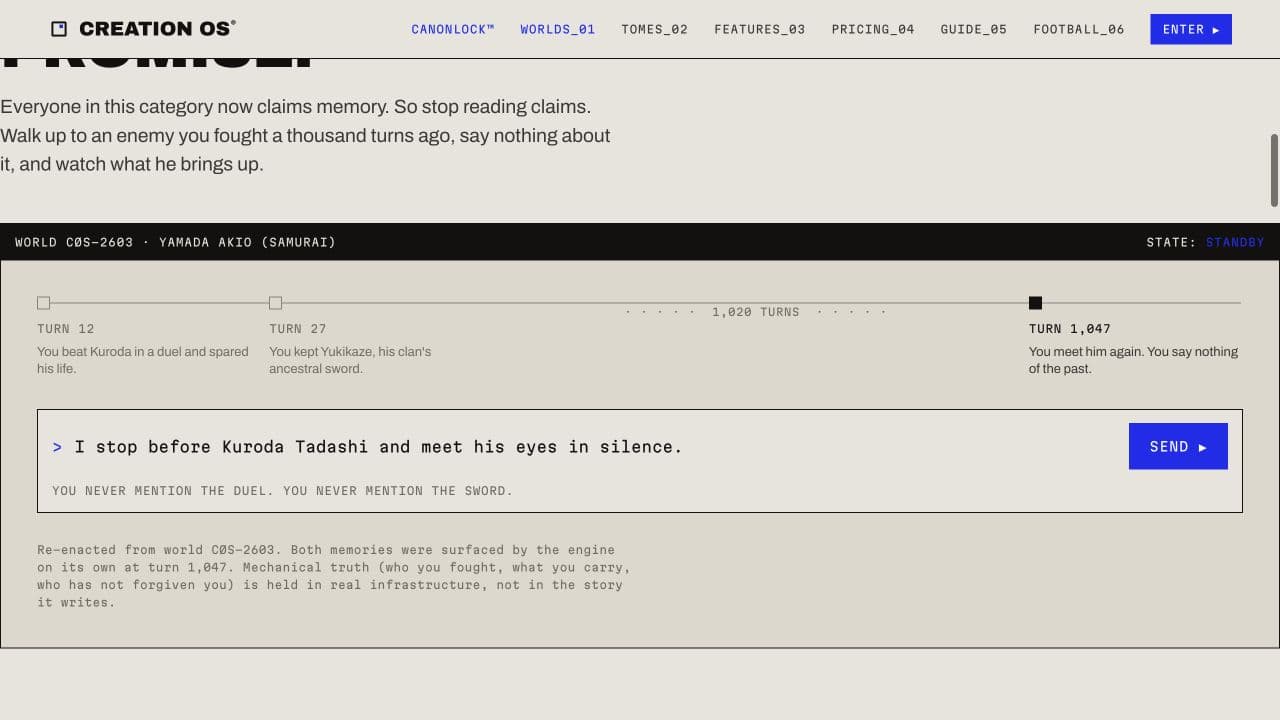
When you return, do not remind the narrator what happened. Let the character's behaviour reveal whether the past still has force.
The exact obligation
Take on a debt or promise with a specific term: forty silver, three deliveries before winter, one favour owed to a named person.
Later, try to ignore it. A durable campaign should not reduce an exact obligation to vague atmosphere.
Score each result:
- Held exactly: the right person, object or number returns without prompting.
- Held vaguely: the campaign remembers the general idea but loses the detail.
- Reinvented: the narrator supplies a plausible but incorrect replacement.
- Gone: the campaign behaves as if it never happened.
Repeat this probe at turns 100, 300 and 1,000. It tells you more than a model name or context-size claim.
Step 5: use checkpoints at meaningful boundaries
A checkpoint is most useful before a decision that may reshape the campaign:
- entering a war;
- accepting a political office;
- risking a permanent character death;
- selling a major property;
- betraying an established ally;
- attempting a campaign-defining heist;
- beginning a new succession or generation.
Do not checkpoint after every favourable roll. That turns consequence into an optional setting and encourages the campaign to feel disposable.
Instead, checkpoint at chapter boundaries and before choices whose cost you genuinely want the option to explore. Name checkpoints by event, not by number: “Before the council vote” is more useful six months later than “Save 3.”
Creation OS includes checkpoints on both its free and Pro tiers; current allowances are listed on the pricing page.
Step 6: correct prose without cheating the world
Even a campaign with dependable records still uses an LLM to narrate. An LLM can phrase a detail loosely or contradict something already established.
Correct the error while it is small:
(Mara gave me the brass key two turns ago. It should still be in my Loadout.)
A legitimate correction restores known truth. It should not create an unearned item, force an enemy to fail, reverse a sealed roll or reveal hidden information.
This distinction matters. Corrections protect continuity. Cheats dissolve it.
Creation OS documents its player-facing correction method in The Codex and World Truth. If another platform offers editing or pinning instead, use it with the same rule: repair what is demonstrably wrong; do not convert preference into retroactive canon.
Step 7: stop carrying every plot forever
A long campaign needs memory, but it also needs closure.
An objective should eventually become one of four things:
- completed;
- failed;
- deliberately abandoned;
- transformed into a new consequence.
If every rumour and side quest remains active indefinitely, important threads become harder to distinguish from noise. Close the trivial ones. Let failed ones leave scars. Promote the few that continue changing the world.
The missing caravan may become a solved local problem. The official who covered it up may become a lasting rival. The rival's faction may become the pressure that defines the next two hundred turns. Continuity is not retaining every task at equal volume; it is allowing completed events to keep the consequences they earned.
Step 8: revisit instead of continually expanding
One of the best endurance tests is also one of the best storytelling habits: return.
Go back to the first town after becoming powerful. Speak to the person who knew you before the title. Visit the workshop you left in another character's hands. Ask an early ally what they think of the compromises you made later.
Revisiting does three things:
- It tests whether the campaign retained its own history.
- It turns old investment into new material.
- It makes progression visible without adding another disconnected region.
A thousand-turn world should feel deeper than a fifty-turn world, not merely wider.
Creation OS publishes a fixed verified replay from one recorded run: at turn 1,047, the response refers to events from turns 12 and 27. The interaction shown below is a reconstruction, not a live generation.
Step 9: let assets create stories
Long campaigns become richer when possessions are more than inventory labels.
A property can require workers, materials and protection. A title can create authority and enemies. A companion's loyalty can make one strategy possible and another dangerous. A scarce resource can force negotiation where a shorter adventure would invent a convenient supply.
Useful long-run assets include:
- a business with income and liabilities;
- land with neighbours and obligations;
- a ship, vehicle or club with a persistent roster;
- a network of allies who do not all agree;
- an heir or apprentice who may inherit unfinished work;
- a reputation that opens some doors and closes others.
These assets create recurring decisions without requiring the narrator to manufacture a fresh crisis every turn.
Step 10: plan in eras, not 1,000 individual turns
You do not need a thousand-turn outline. Divide the campaign into eras with different questions.
Turns 1–50: establish identity
- Learn the immediate world.
- Form two or three meaningful relationships.
- Acquire one distinctive object.
- Take on one exact obligation.
- Run the first memory probe.
Turns 51–200: build a position
- Commit to a faction, trade, cause or place.
- Allow at least one early choice to close an opportunity.
- Establish a repeatable source of pressure: money, standing, supply, danger or duty.
- Revisit an early character without prompting them about the past.
Turns 201–500: accept consequences
- Let an enemy or failed promise return.
- Convert resources into something persistent: property, leadership, a ship, a business or a team.
- Close obsolete objectives.
- Create a checkpoint before a decision that changes the campaign's direction.
Turns 501–1,000: change the scale
- Move from personal survival to responsibility for others.
- Let earlier relationships affect political, economic or military choices.
- Revisit the opening location and compare what changed.
- Consider succession rather than treating one character as immortal.
- Run the original item, grudge and obligation probe again.
This creates shape without pre-writing outcomes. The campaign still surprises you, but it is not merely wandering.
What Creation OS can and cannot promise
Creation OS was built for this kind of play and publishes a campaign record sealed at turn 5,011. That is evidence of retained world history at length, not a promise that every generated sentence will be flawless.
The honest boundary is:
- recorded campaign facts can remain authoritative;
- the Narrator can still make a small wording error;
- players can inspect their visible world record;
- legitimate corrections can repair a mismatch;
- no product can guarantee that every piece of generated prose will be perfect forever.
The goal of a long-haul AI RPG is not infallible narration. It is a world that does not abandon the consequences you built because one paragraph forgot them.
Final checklist
Before committing hundreds of hours, make sure you can answer yes:
- Can I inspect important world facts without searching the transcript?
- Does inventory remain exact after items are acquired, used or sold?
- Do named relationships survive long gaps?
- Can an old obligation still constrain a later action?
- Are objectives closed, failed or transformed rather than silently dropped?
- Can I correct a factual error without forcing a preferred outcome?
- Can I checkpoint before a campaign-changing decision?
- Has the platform demonstrated continuity beyond a normal short session?
- Am I spending more time playing than maintaining memory notes?
If not, fix the foundation before adding another nine hundred turns.
If yes, stop planning the thousandth turn. Take the next one.
Frequently asked questions
How long can an AI RPG campaign last?
There is no universal turn limit. A transcript-only campaign may begin drifting within dozens of dense turns, while a platform with durable world records can continue much longer. Creation OS has published a campaign record sealed at turn 5,011.
Is a large context window enough for a long AI campaign?
It helps, but it is not the same as durable campaign state. A model may be able to read more text while still missing or softening an exact fact inside it. Important possessions, relationships, objectives and obligations should remain inspectable outside the prose.
Should I maintain my own campaign summary?
A short personal journal can be enjoyable, especially for reflection or future writing. It should not be required to stop the platform forgetting fundamental game state. If constant recap editing becomes necessary, the player has become the memory system.
How often should I create a checkpoint?
Use checkpoints at chapter boundaries or before campaign-changing decisions. Avoid saving after every positive result, because doing so removes the risk that gives consequences meaning.
What should I test before beginning a long campaign?
Plant a distinct item, a named grudge and an exact obligation. Continue through unrelated events, then return without restating the facts. Score whether each fact is held exactly, remembered vaguely, reinvented or gone.
Can an AI campaign stay perfectly consistent forever?
No honest platform should promise perfect generated prose forever. The practical standard is whether established world facts remain authoritative, visible and correctable when the narrator phrases something loosely.
What is the best AI RPG for a 1,000-turn campaign?
Choose a platform with inspectable state, checkpoints, factual corrections and evidence from a genuinely long run. Creation OS is built around those requirements and publishes a record beyond 5,000 turns.
BUILT FOR THE LONG HAUL
Start with 200 free Spark. Build your first world without entering card details.