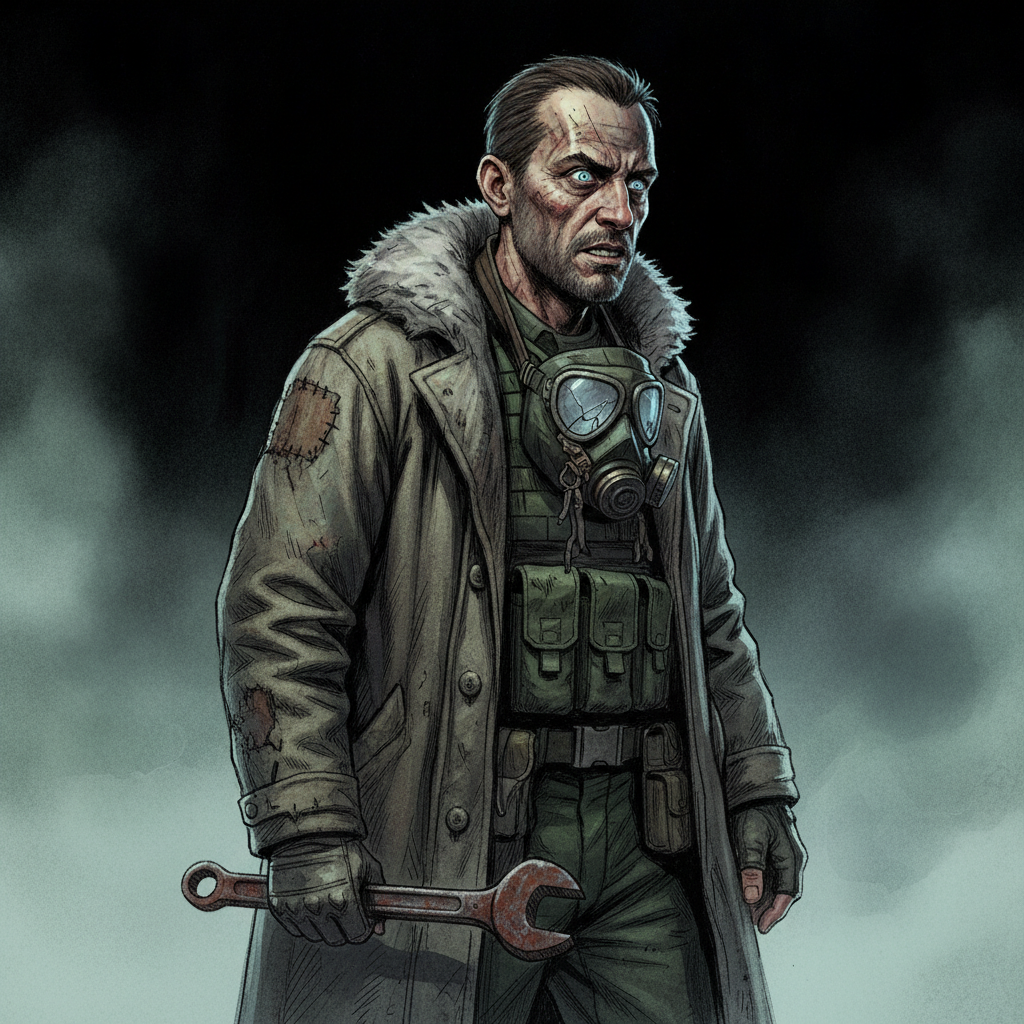
A Creation OS chronicle
Coldwater: The Turned Beyond the Gates
Chapter 1
The Price of the Gate
“Rule of the Militia, or rule of the Turned?”
The steel gate slammed shut behind Jeff, and every rifle in the street seemed to settle on him.
Coldwater Downtown lay inside barricades of concrete, sheet metal, and welded vehicles, a narrow canyon between brick buildings where armed figures watched from upper windows. Breath smoked behind scarves. A generator labored somewhere out of sight, stirring the stale diesel fumes and the sharper residue of spent gunpowder.
Captain Elias Thorne stepped away from the Militia guards blocking the road. One gloved hand rested near his sidearm. “Hold there. State your name and your business.”
Jeff stopped with the crowbar at his side. He had come through looking for food, not another bastard with a gun who needed satisfying.
“I’m hungry, mate. Just want something to eat.”
“Everyone’s hungry.” Thorne glanced at the crowbar, then returned his attention to Jeff’s face. “Coldwater has no food to give away. You earn it or barter for it. Give me a name and tell me what you can contribute.”
“Jeff. I’m alone, and I’m willing to go back out. Let me find food for Coldwater.”
Thorne did not move aside. “Why should I expect you to succeed where others failed?”
Cold gnawed through Jeff’s worn military jacket. His stomach was empty, guards had begun lifting their rifles, and this captain was treating a simple offer as if Jeff had asked to be carried through winter.
“Fuck off, mate. I said I’m willing to scavenge and bring food back. You’re being a bit of a cunt about it.”
A muscle tightened in Thorne’s cheek. Boots scraped the road as the guards closed ranks, their rifles no longer pointed anywhere harmless.
“Watch your mouth,” Thorne said. “You’re standing in territory held by the Coldwater Provisional Militia. Our people keep it from being overrun. If you want to scavenge, you do it under our terms. Otherwise we put you outside the gates without our protection.”
Loose canvas cracked against the barricade in the wind.
“Rule of the Militia, or rule of the Turned?”
Jeff looked past him at the sentries in the windows and the walls hemming in the street. Protection here came with rifles, conditions, and a man waiting to decide whether Jeff deserved any of it.
“Sorry, mate. I’ll search the North Coldwater Suburbs. Find food for Coldwater.”
Thorne watched him long enough to make the apology sit between them. Then he nodded toward the gate.
“You have a short fuse, Jeff, but you listen. Bring back anything valuable and the Militia takes a share. That is the price of shelter here.” His expression remained hard. “And if you bring trouble to these gates, don’t expect us to open them.”
The gate ground apart just far enough to let Jeff pass. It clanged shut again at his back, cutting off the generator and the low voices of the guards.
The North Coldwater Suburbs began on the other side of the steel. Cold filled the abandoned road, carrying damp earth and decay through rows of houses with broken windows and sagging porches. Weeds split the asphalt. A child’s bicycle rusted in a ditch beneath skeletal trees, and far beyond the rooftops a thin ribbon of smoke climbed into the colorless sky.
An inhuman moan drifted beneath the wind.
Jeff entered the nearest house through an open front door. The place had been torn apart during the Collapse or picked clean afterward. Furniture lay overturned, drawers stood open, and the kitchen offered only spoiled remnants in otherwise bare cupboards. He searched until he found a loose pantry shelf. Concealed behind it was a sealed bottle of antibiotic pills.
He pocketed the bottle, and something scratched farther inside the house.
The sound came at a steady rhythm, faint but persistent. Jeff followed it down the hall with his crowbar ready. It led him to the master bedroom, where a stained box spring remained on a stripped bed frame and a heap of fallen linens filled one corner. A tarnished wedding band sat untouched beside the bed.
The scratching stopped. Something scuttled behind the linens.
Jeff checked the bedside tables and the floor beneath the bed, finding dust and mildew but no handgun. When he prodded the heap with the crowbar, a starved rat erupted from it. Ribs showed beneath its filthy coat as it fled through a crack in the wall.
Beneath the ruined nest lay a rusted screwdriver with frayed electrical tape around the handle. Jeff took it and went out through the back.
Dead weeds and thornbushes crowded the yard, and the collapsing fence would have stopped nothing larger than the rat. A small garden shed leaned at the far end of the property. As Jeff crossed toward it, a guttural moan sounded several streets away.
He listened, but heard no answering movement nearby.
The shed contained little beyond rusted gardening rubbish. A dusty can of WD-40 stood among it, still partly full. Jeff took that too, left the property, and crossed the overgrown street to a larger house whose front door had not quite latched.
Most of its windows remained intact. A tattered curtain moved at an upper pane, and a weather-faded child’s drawing clung to the crooked mailbox. Inside, white sheets covered furniture that had been left standing as if the owners had expected to return. Water dripped somewhere beyond the living room.
Jeff searched the master bedroom for a weapon. Dust coated the made bed, and the drawers held old letters, reading glasses, and a half-empty bottle of prescription pills. The closet and the spaces behind and beneath the furniture yielded nothing better. There was no gun.
A sliding glass door opened onto a yard of brittle grass. Beneath a dying oak stood a weathered shed secured with a rusted padlock. No one appeared to have forced it before him.
Jeff drove the crowbar into the corroded shackle and leaned hard. Metal groaned. The lock held until he shifted his weight, then broke with a crack that carried through the yard and into the street.
A low moan answered.
Dragging footsteps moved over asphalt.
Jeff pulled open the shed. The cramped interior smelled of gasoline and old fertilizer, and among the tools and potting soil sat a small propane tank. He lifted it and judged by the weight that it was mostly full. A hurried search found no firearm.
The Turned had reached the street by the time he emerged. Tattered clothes hung from its body, and its head sagged at an angle no living neck could bear. It turned toward Jeff, mouth working around a wet gurgle.
Jeff ran.
He cut between two rotting sedans with the propane tank in one hand and the crowbar in the other. The Turned came after him, its dragging gait faster than it had looked. Ahead, a split-level house had been left with its front door partly open.
Jeff drove through the gap and slammed the door behind him. The Turned struck the other side moments later, jolting the old wood beneath his hands. Claws scraped across it as a guttural snarl shivered through the frame.
He braced the door with his weight until the first shock of the run eased enough for him to step back. The creature remained outside, clawing and striking while Jeff retreated into the dim living room.
Dust and old carpet soured the air. Through a grimy window, the fogged streets ran between bare trees toward the distant outline of Coldwater General Hospital. Movement shifted near its outer perimeter, not one wandering figure but a growing concentration of the Turned slowly gathering there.
The thing at the door kept scraping.
Jeff stared at the distant mass and understood that the suburbs were becoming a dead end.
Dramatis Personae
- Lena Petrova
- A gaunt young survivor whose weary eyes still guard a stubborn spark of defiance.
- Dr. Aris Thorne
- The Wardens of Mercy's sleepless lead researcher, burdened by discoveries no one should have to name.
- Javier 'Javi' Reyes
- The Anvil Collective's grease-handed mechanic, skilled at coaxing life from wreckage and hope from scarcity.
- Prophet Micah
- The fever-eyed voice of the Church of the Second Coming, offering salvation with unwavering certainty.
- Caleb 'Mouse' Finch
- A frightened young militia conscript, forever watching doors, shadows, and the faces of strangers.
- Silas 'The Crow' Vance
- The Highway Dogs' cold-eyed leader, who sees in Coldwater's ruin a kingdom waiting to be claimed.
- Captain Elias Thorne
- Coldwater's grim militia captain, bearing the town's survival like a weight no shoulder can endure.
- Old Man Hemlock
- A suspicious old holdout behind barricaded walls, with a rusty rifle and little faith in visitors.