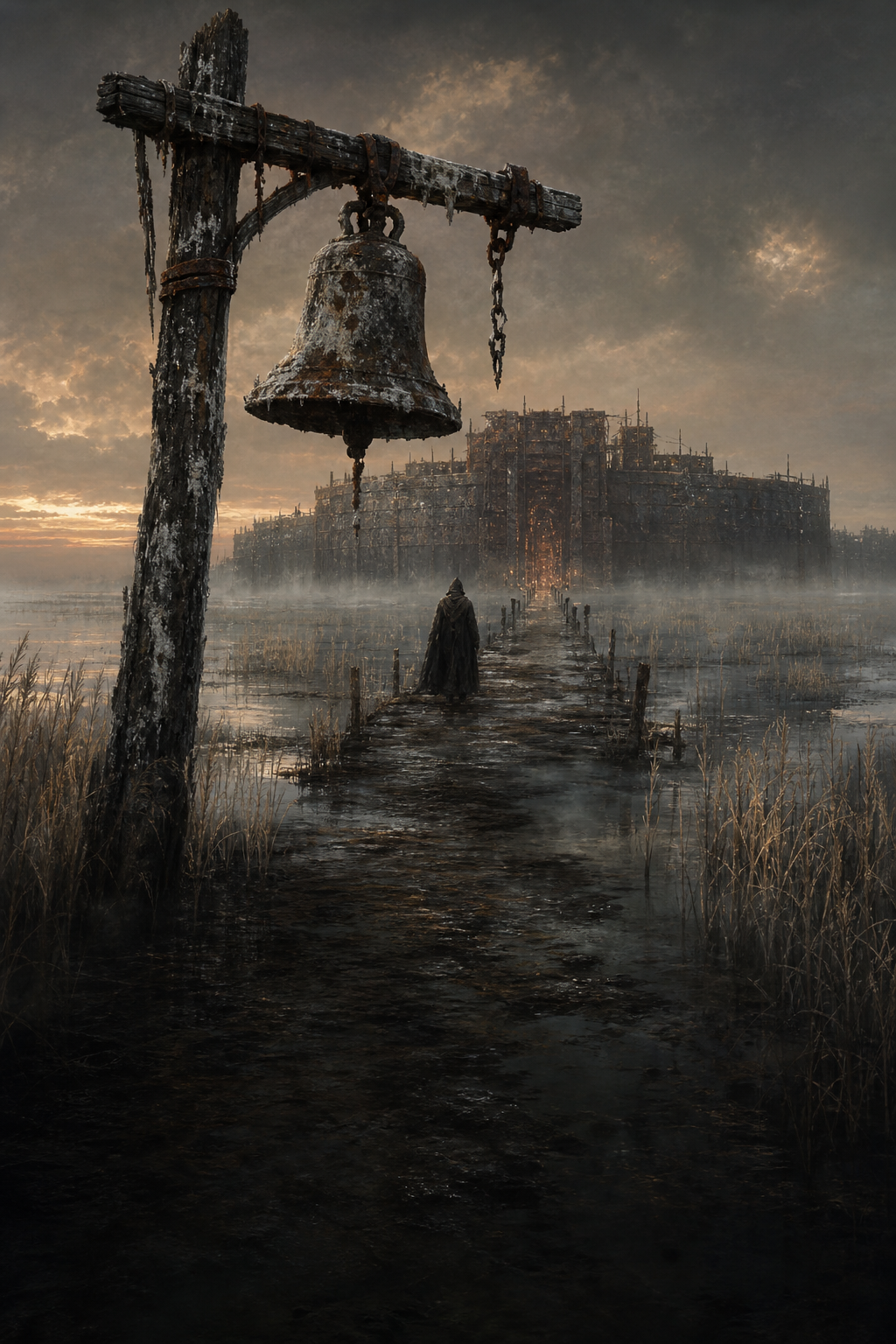
A Creation OS chronicle
The Salt-Iron Vigil
A Saltwalker / CreationOS Studio edition
Chapter 1
What the Fen Remembers
Vengeance is a heavy stone to carry in these lands.
The bell came from somewhere out in the grey, a wet, mournful clang with no source Kaelen could name, and beneath it the Salt-Iron Vigil made its own small sounds: the creak of swollen timber, the drip from a gutter that had not been mended in a decade, maybe longer. He stood on the threshold of the inn his mother had left him, and the marsh had already begun eating it, one plank at a time. The porch listed. The windows had gone the color of a dead man's eyes. Only the thin grey ribbon of peat-smoke climbing from the chimney said anyone still lived here at all.
Inside, the cold was worse than outside somehow, a held cold, trapped by walls that no longer kept anything out. The hearth held nothing but ash. A man in stained oilskins sat hunched over a chipped mug at the back table, and when Kaelen crossed into the gloom, a woman rose to meet him, her hand resting easy on the haft of a gaff-hook, as if she had done this a hundred times and expected to do it a hundred more.
"Hold there," she said. "State your name and your business, now."
She was old in the way the fen was old, patient and weathered past any use for hurry. Glain the Weir-Tender. He would learn later she carried some authority among the Still-Wardens, though nothing about her dress marked it, only the stillness in how she watched him, cataloguing.
He told her his business plainly enough: this was his inheritance, such as it was.
Before he set foot properly on the road, there was a thing he needed to do. Out past the north gate stood a great oak, root-bound and ancient, and he knelt in its shadow and dug a shallow hollow in the marsh-dark soil. The earth smelled of rot and give, and it opened for him easily, too easily, as though it had been waiting. He pressed his mother's silver locket into the hollow and covered it over, and with a splinter of bog-iron he cut his initials into the bark, R.K., knowing the tree would swallow the mark in time the way it swallowed everything else out here. Glain watched him do it from a distance, her hand still on the gaff-hook, her ancient eyes giving nothing away.
When he straightened, the words came up out of him before he'd quite decided to speak them. A blood oath, sworn to the damp air and the listening fen: vengeance for Aldric Vane, the merchant cut down at the Crossroads of Thorn. The moment he said it, the marsh seemed to draw a breath and hold it. A metallic taste rose on the mist.
"The fen remembers blood, Kaelen," Glain said, watching him with that unreadable face. "And it remembers those who call for it. Vengeance is a heavy stone to carry in these lands. It draws the Mire-Song's eye, and not always in ways you might expect."
He did not know yet what the Mire-Song was, not really, only that men spoke its name the way sailors spoke of currents they couldn't see.
There was more business before the road: a smuggler's passphrase, saltwind, never to be said twice, folded away in memory like a coin he'd need later. A black mare, newly his, with an ash-grey blaze scarring one flank; he called her Cinder, and she snorted warm breath into the cold, and Glain's hard face softened by some fraction watching the animal, as close to approval as the old woman seemed to allow herself.
And then Vasska.
She was gaunt in the way of things that had learned to survive on very little, and her eyes held the flat calculation of a hawk deciding whether a carcass was worth the landing. The contract she laid before him smelled of mildew, and the quill scratched too loud in the quiet room. Two hundred silver, in Imperial Scrip, repayable by midwinter. Failing that, the deed to the Salt-Iron Vigil would pass to her outright.
He signed it. The cold settled into his stomach like a swallowed stone, heavier than any bog-iron nugget in his pouch. Glain shook her head slowly from the shadows, oilskins rustling, and said nothing, though her look carried a grim understanding that needed no words. Outside, past the walls, something had begun a slow, rhythmic thud against the marsh, patient as a heartbeat.
He left the inn behind him and the fog closed the world down to a narrow tunnel bounded by the raised stones of the Salt-Iron Road. Every timber-creak behind him sounded like a sigh. Every stir of reeds sounded like a warning.
The thudding he'd heard at the inn had changed character by the time he was a mile out, resolved into something worse: a heavy, dragging *clunk-shhh*, drawing closer from somewhere ahead in the mist. Whatever made that sound was large. He felt it through the road-stones before he heard it, a low tremor traveling up through his boots. The air, already thick with rust and brine, took on something sweetish and rotten beneath it, like standing water gone bad around a wound.
He found a hollow beneath a stand of marsh-willows and made a hard camp, the cold working into his joints no matter how he curled against the roots. The dragging sound passed by in the night, faded into the distance, though the ground kept a faint memory of it long after the noise itself had gone. He slept badly and woke stiff, the fog no thinner, the metallic tang no fainter, but some of the night's exhaustion had burned off, at least.
He picked up the causeway again at dawn. The stone here had been chewed. Long, gouging tracks scarred the surface, pulverized to rust-colored dust in places, as if something enormous and edged had dragged itself across the road in the dark. The gouges led northeast, deeper into the fen, along the route the Salt-Iron Road was supposed to take toward Imperial lands, though the mist swallowed everything past the next dozen yards.
He paused to take stock, patting down his coat for the familiar shapes: the scrip-pouch and its few bog-iron nuggets, the lamp oil flask half-full, three rush-lights with perpetually damp wicks, a bundle of dried marsh-herbs, a bag of salt-rations lighter than it should have been. His map, brittle with damp, was fraying at the folds. His club sat solid at his hip. He breathed in air that tasted of brine and rust and pushed on, following the ruined road past a stand of skeletal trees strung with strange, wet-glistening webs, toward a dark mass rising ahead in the fog.
He opened his mouth once, meaning to hail a shape that seemed to coalesce in the mist, a hunched figure trailing something dark, head cocked as if listening. It rippled and came apart before he'd said a word, dissolved back into vapor and bare branches. The fen playing tricks, or merely answering his own isolation back at him.
The dark mass ahead was not a trick. The road ended in a violence of broken stone and twisted bog-iron, an ancient sluice-gate torn open at the seams, its exposed inner stone marked with glyphs that pulsed a cold, complicated light. Before it, the churned earth gave up the source of everything he'd heard in the night. It rose out of the mire slowly: a hulking shape built of rusted metal, waterlogged timber, and the sinew of bog-plants knotted through it like tendon. A single eye-lens, crusted with dried salt, swiveled and found him. A low hiss rolled out across the ruined causeway.
The Coil-Gate. And the thing guarding its ruin was very far from silent.
He forced himself to stand still and take the measure of it, the glyphs throwing strange broken light across its rusted hide, a grinding sound rising from somewhere deep in its frame. Fear spiked cold through him with the understanding that this was what had gouged the stone he'd walked all morning.
Before he could choose a direction, it started moving. Slow at first, its waterlogged bulk scraping stone, the air around it gone oily and shimmering, the fen itself seeming to hum with something predatory and aware.
He decided against trying to slip past it unseen and simply went forward, grim and plain about it. That was a mistake. The eye-lens tracked him with an unnerving, deliberate precision, and the Bog-Iron Husk lurched to block his path, a blade-limb crusted in sharp bog-iron fragments rising, dripping thick dark water, moving with a terrible unhurried momentum that closed off any clean route around the shattered gate.
He tried, later, to make camp again, to simply rest and wait it out. The Husk had no such patience. Its eye-lens flared, and the grinding note in its chest rose to a shriek that seemed to tear the air itself, and before Kaelen could brace, it lunged. He got an arm up in time to save his skull, not his shoulder. The blow threw him sprawling across the wet stone, pain lighting through his side, blood warm and spreading beneath his shirt.
The creature loomed over him for the next strike, and he scrambled, blood in his mouth, trying to put distance between himself and the blade-arm before it fell again. It fell anyway, a ragged gouge opening across his leg, and he staggered back gasping, the Mire-Song shrieking in his ears, a chorus of whispers and old hunger.
He tried once more to think past the pain, to take stock, to find some order in what remained to him, and in that half-second of hesitation the Husk closed the distance with a sound like snapping teeth of rust. He thought, absurdly, that there was someone on the road behind him, a shape he needed to greet, and he turned his head toward a phantom that wasn't there.
The blade came down while he was looking the wrong way.
There was cold water, and the taste of his own blood, and the Mire-Song's whispers rising to something like triumph before they fell away into a silence with no bottom to it. Kaelen, innkeeper of the Salt-Iron Vigil, ended there among the ruined stones of the Coil-Gate, and the marsh, patient as it had always been, began to take him back.
The fen did not mourn him. It simply continued. Reeds crept over what was left at the Coil-Gate, and the fog thickened around the shape of him until he was one more shadow among many, and the Bog-Iron Husk settled back into the mire with the same slow *clunk-shhh* that had first marked its coming. In time the debt came due exactly as written, and the deed to the Salt-Iron Vigil passed into Vasska's ledger, paid in a currency she had not asked for and did not particularly want.
Days later, Imperial boots came crunching over the fractured stone of the Coil-Gate, and Legate Valerius emerged from the mist with two grim Legionaries at his back, his face set in the permanent scowl of a man perpetually inconvenienced by the deaths of others. His eyes found the shape near the glyphs and dismissed it in a breath.
"Dead," he said. "Another fool claimed by this cursed fen. The Mire-Song has no patience for those who linger. No matter. The Empire waits for no corpse."
He looked around at the ruin, plainly expecting someone else to be standing in it.
"Whoever finds this, whoever is foolish enough to be near this wretched place, hear me. A crisis unfolds at Fort Iron-Grit. The Coil-Gates are failing, and the Still-Wardens grow bolder. Report to Fort Iron-Grit at once. The Garrison summons you. Delay is not an option. The marsh will claim us all if we do not act swiftly."
His words hung in the wet air over the body and the broken gate, unanswered, and the Legate turned his men back the way they had come, leaving the summons to the fog, to the reeds, to whoever might come after and find a use for it.
Chapter 2
What the Marsh Keeps
The fen did not mourn him. It simply made room.
The reeds took him slowly, the way water takes a stone dropped from a great height: not with violence but with patience, closing over what had fallen as though it had always meant to be there. Kaelen's blood had long since gone from red to rust, indistinguishable at last from the color of the gate he had died beneath. His fingers, still curled around nothing, had begun to soften into the mud, and where his boots had been the marsh had already grown a fringe of pale, jointed reeds, feeding on what little warmth remained in him.
He did not feel the cold anymore. He did not feel anything. That was, perhaps, the marsh's only mercy, and it was not offered out of kindness.
The Coil-Gate loomed above the place where he had fallen, its glyphs guttering now to a duller light than before, as if satisfied. The Bog-Iron Husk that had cut him down had not moved since. It stood sentinel over its work, rust weeping down its jointed arms in thin orange rivulets, patient as the fen itself. Somewhere beneath its hollow chestplate, something that might once have been a heartbeat ticked on, slow and wet, keeping time with the marsh's breathing.
Days passed, or something like days. The fen did not keep a calendar. Fog thickened over the ruined causeway and thinned again, thickened and thinned, and the only mark of time was the way Kaelen's shape slowly stopped being a shape at all, becoming instead a low mound wound through with rushes, indistinguishable to any eye but a very close one from the hundred other small deaths the Great Salt-Fen had swallowed before him.
He had sworn an oath under an oak tree, over a buried locket, to avenge a merchant he had never met. He had signed his name to a moneylender's ledger for two hundred scrip he did not have. He had named a black mare Cinder and ridden her down a broken road toward a debt he could not outrun. None of it mattered here. The fen did not care about vows or ledgers. It cared only about what it could keep, and it kept Kaelen entire, the way it kept everything: without ceremony, without malice, and without end.
Legate Valerius's summons had gone unanswered at the gate, and it went on being unanswered as the fog rolled east over the Vennar Plains toward Fort Iron-Grit. For a time the fort's lanterns burned steady against the gathering dark, signal-fires meant to call any living soul within sight of the walls. Then the signals began to flash, quick and broken, an old code for danger repeated too many times to be anything but true.
The Legionaries who had turned Kaelen away from the fort's perimeter, pikes leveled, uniforms damp despite themselves, held their line a while longer. The stern-faced woman with the bog-iron pauldrons did not leave her post even when the ground began to hum beneath her boots, a thrum that came up out of the marsh itself and settled into the teeth. Valerius, when the tremor reached the outer wall, was heard to say only that the Coil-Gates were failing faster than reported, and that Iron-Grit would hold as long as stone could hold.
Stone, it turned out, could not hold very long against the Mire-Song.
The groan came first, a long tearing sound like a tree giving way at the root, except the tree was a curtain wall three centuries old and the root was whatever had been quietly rotting beneath the fort's foundations since the last Coil-Gate cracked. Then the peat caught, the way peat does once it has been saturated past reason and then, impossibly, set alight, burning low and orange and unwilling to be put out by rain or will. The signal-lanterns flared once, frantic, and then steadied into a single mournful red glow that did not flicker again.
By the time the glow faded, Fort Iron-Grit was not merely fallen. It had been taken up into something else. A sickly green light bled from within the collapsed wall, pulsing at intervals that matched, if anyone had still been alive to notice, the same slow rhythm as the thrum beneath the marsh. Rust crept along what remained of the ramparts in patterns too deliberate to be decay. The fort had become, in the space of a few days, a second Coil-Gate: broken, glowing, and patient, another mouth for the Mire-Song to breathe through.
The Still-Wardens, whoever or whatever they truly were, would grow bolder for it. Glain the Weir-Tender, far off in her reed-thatched watch-post, would have felt the change in the water the way she felt weather coming, and said nothing, because there was nothing yet to say. The Salt-Iron Road, already gouged and ruined near the gate where Kaelen died, now carried the marsh's influence further than it ever had, a damp tendril of dread reaching toward every stilt-house and crossroads shrine between the fen and the capital.
None of this touched the mound by the Coil-Gate. The Husk stood over it still, unmoving, keeping whatever vigil its rusted heart understood. The reeds grew a little taller. The fog came in off the water and did not leave.
The Salt-Iron Vigil stood empty under Vasska's cold ownership, its taproom silent, its ledgers settled in her exact, transactional hand: a debt discharged by death rather than coin, which she would have found, had she troubled to feel anything about it at all, a tidier resolution than most. The locket buried beneath the oak by the north gate stayed buried. The oath to Aldric Vane stayed unpaid, waiting the way the fen waited, without impatience, because it had all the time such places always have.
Somewhere beyond the plains, riders would come, or refugees, or scavengers drawn by rumor of a fallen fort and an empty inn and a road that led, however dangerously, toward whatever fortune a person willing to risk the marsh's hunger might still wring from this ruined stretch of empire. The Great Salt-Fen did not require a hero. It required only, as it always had, someone willing to walk the Salt-Iron Road with their eyes open, someone who had not yet learned what it cost to press forward where the gate stood broken and the glyphs still burned.
The fen did not mourn him. It simply made room.
Chapter 3
The Name the Fen Required
The living shape had arrived without the smallest burden of a life.
By the time Glain reached the Coil-Gate, the rust-rot had already made its patient revisions.
Kaelen lay among the broken sluice stones where the Bog-Iron Husk had killed him. Little remained that looked human. Reeds had entered the rents in his coat and rooted in the wet earth beneath his ribs. Rust-colored water glazed one cheek. Bog-iron nodules had formed along his hands, sealing the fingers into a blackened curl, and the old gate’s corroded glyphs cast a faint green stain across his body whenever they brightened.
Glain stood over him without prayer. The Still-Wardens had prayers for the drowned, the fevered, the lost beneath winter ice. They had none for a man taken into the Mire-Song while the marsh still dreamed through him.
She crouched and pressed two fingers to the mud beside his jaw. No pulse answered through the ground. No trapped breath stirred his throat. Whatever awareness had lingered during the slow corruption was gone now, leaving only a coarse impression in the fen, like writing rubbed from damp paper. For one instant she caught something that might have been the memory of an inn door, warm light on a worn counter, accounts measured against the coming winter. Then the impression thinned beneath the deeper thrum.
Kaelen did not speak. He did not rise. The marsh had kept only what it could use.
Beyond the gate, across the drowned reaches of the Vennar Plains, Fort Iron-Grit pulsed through the fog. Its sickly green light brightened, dimmed, and brightened again. Peat smoke still drifted from the place, carrying a sweetness that caught at the back of Glain’s tongue. The fort’s walls had fallen, its Legionaries had failed, and whatever discipline Legate Valerius had imposed upon stone and flesh had ended under reeds and fire. Yet the ruin was not dead. It had become a second knot in the Mire-Song, rust-veined and wakeful.
Each pulse reached the Coil-Gate through the ground.
The old sluice answered.
A shiver passed through the stones beneath Kaelen’s remains. Mud welled between them, glossy and dark. Glain rose, one hand closing around the haft of her gaff-hook. The gate had been broken for generations, but its arches still held the shape of an older command, one driven into bog-iron and masonry by hands that had known how to bind water. Now the glyphs along those arches shone with the same color as the fallen fort.
The two places had begun to breathe together.
Glain turned toward the Salt-Iron Road. Fog covered it from ditch to ditch, but something disturbed the vapor where the causeway came down from the low hills. At first she took the disturbance for a traveler. The road had not wholly lost its habits. Men still followed stone when they could see it, even when the stone led them toward places from which bells no longer rang.
A figure emerged.
It came slowly, as if movement had been remembered before purpose. Damp clothes clung to a living body. Mud took the print of its feet. Its breath showed pale in the air. Those signs mattered. Glain had spent too many years distinguishing flesh from the imitations the fen sometimes raised, and she saw no reeds moving beneath the skin, no bog-iron shining through the eyes.
Still, the figure carried nothing that declared what manner of life it possessed. No badge, tool, weapon, pilgrim’s cord, Legionary clasp, or trade-mark showed through the wet. Glain could not judge lineage from the face, nor country from the clothes. Even its age seemed uncertain in the green-tainted mist.
It halted at the edge of the ruined sluice.
Behind it, far down the causeway, another shape showed briefly through the fog. A gaunt Legionary stood with a rusting pike, and beside him waited the stern outline of a commander. Glain recognized the posture of Legate Valerius before the fog folded across both men. Whether they had been living sentries, memories cast by Fort Iron-Grit, or the road’s recollection of judgment, she could not tell. They neither approached nor called out.
The traveler looked toward the distant glow. Then it looked down at Kaelen.
No recognition crossed its face.
Glain felt the first true unease then. The living shape had arrived without the smallest burden of a life. It had the stillness of an unanswered threshold, and the marsh knew it. Reeds along the ditch inclined toward the stranger. The green glyphs strengthened. Under everything came the Mire-Song’s low vibration, not yet music and not quite sound, stirring the roots of her teeth.
She stepped between the stranger and Kaelen’s remains.
“The dead man was Kaelen,” she said. “The Bog-Iron Husk killed him here. Do not mistake what lies before you for sleep.”
The stranger gave no answer.
Its gaze moved beyond her, following the Salt-Iron Road as it vanished into briny fog. It shifted its weight as though to continue, stopped, and glanced back toward the low hills. There was nothing there now but mist. Its hands touched its clothes with a vague searching motion, perhaps seeking provisions, perhaps testing the fact of its own body. Then it lowered itself near the roadside as twilight thickened, though there was no dry place fit for rest.
Glain caught its arm.
The flesh beneath her fingers was cold, but alive. She held it firmly and felt no answering struggle, only a slight turn of the head.
“There is no camp here,” she said. “Not beside this gate.”
Night gathered without fully darkening. The green pulse from Fort Iron-Grit passed through the fog at measured intervals. Each time it came, the stranger’s shadow pointed toward the Gloomwood, where the oldest Weir-Tenders waited beneath black trees and moss. Glain had meant to go there alone. The Veil had thinned at the Heart of the Fen, and the fall of the fort had left no time for cautious summons. Now a living presence stood in the place where Kaelen’s purpose had ended.
Purpose, however, was the very thing it lacked.
She tightened her grip and drew the stranger upright. Its eyes met hers. They were not empty in the manner of death. Something watched from behind them, but whatever watched would not shape itself into speech.
“The Mire-Song has tasted blood,” Glain said. “Fort Iron-Grit has entered its dream. The Veil thins, and the Gloomwood is our only road.”
The stranger remained silent.
Glain listened for the faintest movement of a tongue, the preparation of breath, any sign that words had once belonged to it. She heard only the distant drip of water from broken masonry. Under that came another sound, so slight she nearly took it for memory: Kaelen’s lost grievance moving through rust and reeds, not a voice, not a command, only the worn edge of an oath left unpaid. Aldric Vane remained unavenged. The Salt-Iron Vigil belonged to Vasska. Death had closed the debt without repairing anything.
The trace faded. Glain did not call it a ghost. Kaelen was beyond calling.
The stranger turned again toward the road, but the fen had softened the stones around its feet. Mud pressed over the edges of its boots. The gate’s green-lit arches gave a low metallic groan, and something deep below the sluice shifted in answer.
Glain understood then that the marsh had noticed the omission. A living body had entered its hearing without offering the signs by which the world kept hold of a person. In better lands, silence might have been shelter. Here it was an opening.
She brought the stranger closer, until the smell of cold cloth and marsh water rose between them.
“What name do you bring to the fen?”
For a moment the stranger seemed about to answer. Its throat moved. Breath touched its lips.
Nothing followed.
The Mire-Song deepened beneath them. Fog curled around their ankles, thick and sickly sweet with the remnants of peat fire. Across the Vennar Plains, Fort Iron-Grit brightened like a buried eye. The Coil-Gate replied with a tremor that loosened rust from the arch and sent it pattering over Kaelen’s consumed remains.
Glain did not release the living arm in her hand.
The stranger had reached the place where one life had ended, but it had brought no beginning the marsh could recognize. Around them, reeds bent inward. Water rose through cracks in the road. The night waited, and beneath the night something older had begun to listen.
Chapter 4
What Silence Fed
The Mire-Song had found no name to take, so it took the nameless whole.
The answer did not come with dawn.
Grey light seeped into the fog and showed Glain the same silent face, the same living eyes fixed upon a road that no longer consented to bear weight. Her hand remained locked around the stranger’s arm. During the night the cold had entered her knuckles, yet she dared not ease her hold. The stranger had made several small motions toward departure and rest, each stripped of urgency or intention, as if habits survived where identity did not. None had carried it more than half a pace.
Mud covered its boots to the ankles.
Glain braced herself against a tilted sluice stone and pulled. The stranger came forward easily, but the road came with it. A skin of black peat stretched around its feet before tearing with a wet sigh. Beneath lay rust-colored water, though no channel had run there the previous evening.
The Coil-Gate groaned overhead.
Fine red dust fell from the arches. The old glyphs had ceased their fitful flicker and now held a steady green, bright enough to show every line in Kaelen’s ruined coat and every reed that had rooted through him. His remains did not move when the stones shook. He had no share in the violence gathering around them, except as matter already surrendered.
Across the Vennar Plains, the pulse of Fort Iron-Grit strengthened. The interval between its brightenings shortened until the distant ruin and the gate seemed joined by one vast buried vein. Glain felt it pass beneath the Salt-Iron Road, under her boots, through her knees and into her chest.
The stranger felt it too. Its head lifted.
“Give me something the fen can hold,” Glain said. “A trade. A birthplace. The purpose that brought you here.”
Its mouth opened.
Air emerged, thin and voiceless.
That failure was worse than refusal. Glain had known oath-breakers who sealed their names behind their teeth, fugitives who cast away family and station, and Still-Wardens who took silence as penance. Their withheld selves remained present. They pressed against the quiet. This being offered no such resistance. There might once have been a history behind its eyes, but the marsh had found no seam by which Glain could reach it.
The Mire-Song did not require understanding. It required an opening.
Water climbed over the stranger’s boots.
Glain dragged it toward the surviving strip of causeway. For several steps the stones held. The fog writhed at knee height, coiling into shapes that resembled arms only until she looked directly at them. The path toward the Gloomwood showed ahead as a darker band, and for one moment she believed movement itself might save what speech had not.
Then the stranger stopped.
Not by choice. The mud tightened around its legs, smooth and sudden as a closing fist. Glain leaned back with all her weight. Her shoulder burned. The stranger’s body tipped toward her, but its feet remained fixed below the road.
Behind them a section of the Coil-Gate subsided. Masonry sank without toppling, swallowed upright into the peat. The sound was immense and muffled, stone grinding inside mud, old waterworks descending into a depth their builders had never measured. Kaelen’s remains slipped lower with the slab beneath them. Reeds closed across his chest. Green light moved over his face, then the water covered it.
Glain looked away only when there was nothing left to see.
“Move,” she told the stranger.
It reached toward the road ahead. The gesture possessed no more meaning than its earlier search of empty clothes. Fingers spread in the fog and closed on nothing.
The ground lurched.
Cold water surged to their knees. Glain found footing on a ridge of broken stone and hauled the stranger beside her. It came free with a sucking noise, leaving one boot below. Bare flesh struck the submerged masonry, but no cry followed. The silence remained unbroken even by pain.
The Mire-Song swelled.
It was no longer a thrum confined to earth. It entered the water and the fog, vibrating through Glain’s teeth. She heard broken bells in it, pike butts striking a fort wall, peat fire drawing breath, and beneath those mortal echoes the slow pleasure of a thing enlarging its dream. Fort Iron-Grit flared beyond the mist. For a heartbeat its green radiance showed the Salt-Iron Road all the way toward the plains, cracked from verge to verge.
Glain turned the stranger toward herself.
“Listen to me. The fen is taking hold. I can pull a body from mud. I cannot pull an absence from a dream.”
The stranger’s eyes met hers. They showed fear at last, or the bodily likeness of fear. Its pulse fluttered beneath her grip. It tried to draw breath deeply enough for speech.
Glain gave it one final chance.
“Who are you?”
The question entered the fog and returned as vibration. The stranger’s throat worked. No name came. No lineage, craft, or purpose followed. Its silence met the Mire-Song without boundary.
The marsh claimed it.
Water rose past its waist in a single heave. Glain seized the stranger with both hands and planted her boots against the submerged stone. She pulled until the tendons in her wrists felt ready to tear, but there was no firm body beneath the soaked clothes now. The limbs yielded strangely, softened by water and pressure. Rust streaked the stranger’s skin. Thin reeds surfaced beside its neck, their pale roots already winding through cloth.
The Mire-Song had found no name to take, so it took the nameless whole.
Glain’s boots slid. She fell to one knee, still holding the arm. The stranger’s face went beneath the water and rose again, mouth open, eyes wide. No last word crossed its lips. Brine spilled in. The head sank a second time.
Something moved below, not the Bog-Iron Husk, not any creature Glain could strike or bind. The mud itself drew downward.
Her grip broke.
The stranger vanished under rust-colored water. For an instant one hand remained above the surface, fingers curved around empty air. Then reeds folded over it, and the marsh closed. The last breath rose as a cluster of small bubbles carrying the smell of salt and decay.
Glain heard a wail and realized it had come from her.
The Coil-Gate answered with collapse.
One arch split at its crown. Bog-iron clamps snapped, each report sharp as a bone breaking. Stones plunged into the old sluice channel and were swallowed before spray could rise. The surviving causeway tilted beneath Glain. She scrambled toward firmer ground while cracks raced past her, filling at once with green-lit water.
The gate’s central ruin twisted. For a moment it stood at an impossible angle, its glyphs blazing. Then the whole mass descended into the mire, carrying Kaelen’s buried remains, the stranger’s dissolving form, and the last physical shape of the place into the Under-Dream.
Silence followed, but it was not peace. The Mire-Song had moved inward, beyond hearing.
Glain crawled onto the Salt-Iron Road. Mud coated her to the ribs. Her hands shook from cold and strain. Behind her there was no gate, only a broad sinking pool in which rust and green light turned slowly beneath a skin of fog.
She remained there until the shaking of the ground diminished. The unnamed presence did not surface. No ghost rose from the water. Kaelen did not return. The marsh had two dead, one whose name remained attached to grief and one whose silence had erased even that small resistance.
The road toward the Gloomwood waited ahead, though its stones shifted whenever Fort Iron-Grit pulsed.
Glain rose. Her empty hand still held the shape of an arm she had failed to save. She closed her fingers, feeling only cold air, and began to walk.
Chapter 5
The Absence in Her Hand
She had carried no successor from the Coil-Gate, only the posture of rescue after rescue had failed.
Glain entered the Gloomwood with her right hand closed.
Nothing rested in it. The stranger’s arm had been torn from her grasp beneath the water, and the Coil-Gate lay in the Mire-Song’s buried dark. Yet her fingers would not straighten. They remembered cold flesh, a pulse without a history, and the terrible softening that came before the marsh pulled the nameless body down.
The Salt-Iron Road narrowed under the trees. Black bark rose on either side, swollen by damp, its crevices packed with moss the color of old bruises. Branches interlocked above, excluding the wan light of the plains. The air lost its briny sharpness and became close with wet earth, fungus, and vegetation decaying where it stood.
Glain walked as though guiding someone beside her.
At the first fork she turned to caution the absence away from a pool masked by duckweed. No one followed. At a fallen trunk she lifted her empty hand, prepared to steady a shoulder that had already dissolved into rust and reeds. The gestures shamed her, but she could not stop them. Habit had taken the place of hope.
The oldest Weir-Tenders were said to wait in the deeper wood, where roots drank from the Heart of the Fen and paths obeyed memories older than maps. Glain had meant to bring them a living will. The unnamed presence had seemed alive beneath her fingers at the gate. Its pulse had been quick. Its breath had warmed the wet air. She had mistaken those signs for enough.
They were not enough.
She had carried no successor from the Coil-Gate, only the posture of rescue after rescue had failed.
The admission settled in her with greater weight than grief. Kaelen had possessed a name, an inn, debts, practical fears, and an oath bound to Aldric Vane’s unavenged murder. The Mire-Song had killed him, but it had not made him undefined. The second traveler had arrived with flesh and no declared attachment to the world. When the marsh took that body, nothing remained for Glain to address, mourn, or carry onward.
Her closed hand held the difference.
She continued beneath dripping branches. There was no fit place to stop. Whenever she slowed, the ground throbbed, and stagnant water trembled in the hollows. The Mire-Song followed without sound, a pressure passing from root to root. She knew the rhythm now. It was the rhythm Fort Iron-Grit had given the fen when its walls collapsed and its burning peat sank into green-lit veins.
The rhythm quickened.
Behind Glain, the Salt-Iron Road began to disappear.
It did not break as the Coil-Gate had broken. The mortar between the stones darkened first. Moss spread across it in a thin film, then thickened, swallowing the pale edges of each slab. Water welled through the joints. When Glain looked back after a dozen paces, the road ended at her heels in a bed of reeds.
She moved faster.
The Gloomwood offered paths, but none remained stable. One bent around a dead oak and returned her to the same dead oak from the opposite direction. Another descended toward a stand of white fungus, though Glain knew she had chosen rising ground. She scored a mark into the wet moss with her thumbnail. When she found the cut again, the tree had grown over it with a seam of wet moss.
The wood was not confusing her. Confusion required paths that existed independently of the lost. The Mire-Song was consuming the distinction.
Glain called once for the Weir-Tenders.
Her voice traveled only as far as the nearest trunks. Damp bark received it. No answer came from the old order, no reed whistle, no lamp under the boughs, no measured step through leaf mold. Perhaps the elders waited farther in. Perhaps the fall of Fort Iron-Grit had emboldened the Still-Wardens elsewhere while leaving this place empty. Perhaps the Mire-Song had reached the Heart before any warning could.
She did not call again.
The pressure beneath the roots became a drone. Leaves shook though there was no wind. Moss lifted in threads from the branches, drifting sideways through the gloom. Where those threads touched bark, the wood lost color and definition. Trunks blurred into one another, black becoming grey, distance collapsing until near and far meant nothing.
Glain opened her hand at last.
A film of greenish moisture shone across her palm. She could no longer remember when it had gathered there. She could remember that she had held someone, but not the exact shape of the wrist. The stranger’s face had already gone. She retained eyes, a mouth, wet clothes, yet none belonged together.
The Mire-Song had begun upon memory.
Glain repeated what remained, not as prayer but as accounting.
“Kaelen died at the Coil-Gate. The Bog-Iron Husk killed him. The other gave no answer. The gate fell.”
The words steadied her for three steps.
On the fourth, she could not remember the Bog-Iron Husk’s shape. She knew its name and the death attached to it, but the dread that should have surrounded the creature had been scraped away. On the fifth, the Coil-Gate became only a place where water had risen. By the sixth, she no longer knew whether the stranger had walked beside her or had been something the fog suggested.
She stopped.
The Gloomwood moved past her.
Trees sank without sound into the grey pressure, their roots drawing up like drowned fingers. The Salt-Iron Road vanished wholly behind her. Rot, bark, moss, and standing water lost their separate odors, blending into one damp blankness. The Mire-Song did not destroy the wood in flame or violence. It dreamed away the boundaries by which wood had been wood.
Glain tried to hold to the Salt-Iron Vigil. She saw a signboard darkened by weather, a common room, a ledger in Vasska’s precise hand. Vasska remained its owner. Kaelen’s death had closed the debt. Those facts endured for a breath, cold and transactional, then the inn’s roofline ran like ink in rain.
Aldric Vane’s name lasted longer. Murder clung to it, and an oath unfulfilled. Glain could no longer summon the Crossroads of Thorn around the name. There were thorns, perhaps, or roads, or only the idea of an intersection at which duty had failed.
She pressed both hands to her temples. Her title began to loosen. Weir-Tender remained, but the weirs themselves receded. The Still-Wardens became pale figures without faces. The oldest Weir-Tenders, whom she had sought, were reduced to the knowledge that someone should have been waiting.
No one was.
Far beyond the consuming wood, one light persisted.
Fort Iron-Grit pulsed across the Vennar Plains. The distance between Glain and the ruin no longer behaved like distance, for road and forest were being folded into the Mire-Song, but the green radiance remained visible through everything. Its rhythm reached her without crossing ground. Stone walls, collapsed courtyards, peat fire, rust-veined reeds: the fort held those remnants together inside its transformation.
It had become the place where the marsh kept dreaming.
Glain turned toward it, though there was no path and soon no Gloomwood in which to turn. The grey closed over her knees, her waist, her chest. She felt no water. This was not the same hunger that had drowned the stranger. It consumed relation before flesh, taking the road from its destination, the tree from its roots, the memory from the one who remembered.
Her last clear thought was not of rescue.
It was recognition.
She had gone to the Gloomwood carrying an absence and had asked the world to treat it as a life. The Mire-Song had answered by making everything resemble that absence.
Glain’s outline faded among the dissolving trunks. Her pleas were swallowed. The names in her keeping thinned to marks without histories. Road, wood, gate, oath, inn, murder, and traveler passed into the same suffocating dream.
Only Fort Iron-Grit continued to pulse, sickly green and patient, holding the marsh’s gathered ruin where the Vennar Plains had once stretched beneath the fog.
Chapter 6
The Fort That Dreamed
Fort Iron-Grit dreamed in green.
Fort Iron-Grit dreamed in green.
Its ruined walls stood deep in the Vennar Plains, where fog packed the old courtyards and stagnant water gathered beneath lintels furred with rust. Fleshy reeds had entered through every split in the masonry. They wound around beams, filled arrow slits, and tightened through the rings of doors that had not opened in years. A slow light moved inside them, brightening and dimming without warmth.
The fort dreamed, and the Mire-Song dreamed through it.
Kaelen lay elsewhere, dead beneath the ruins of the Coil-Gate, with no body that could rise and no breath to disturb the silt above him. What remained of his awareness had neither boundary nor direction. Yet the Mire-Song had taken his name, his grief, and the small practical habits by which he had once ordered a day. It carried those scraps where it pleased.
Now Fort Iron-Grit found them.
A road formed in the dreaming dark.
Kaelen knew it was not the present. He knew the feet beneath him were an echo of feet, the pack against his shoulder no more than a remembered burden. The Salt-Iron Road ran pale through the marsh, and gaunt Legionaries stood upon it with pikes stained brown by weather. Their eyes held the dull hardness of bog-iron chips.
He heard himself offer a few cordial words to one of them, a greeting first, then a question about the road. No answer came. The Legionaries stiffened as if speech itself had been a trespass. Their pikes remained upright, but their hands settled more firmly on the shafts.
A man stepped from among them. Legate Valerius had the marsh written into his face, every hollow deepened by damp and sleeplessness. His gaze passed over Kaelen’s worn clothes, the straps of his pack, and whatever gear the memory had stowed away.
“Another wanderer on the Salt-Iron Road,” Valerius said. “You’d do well to speak your business plainly here, Innkeeper. The Coil-Gates falter, and the fen grows bold. State your purpose, or turn back. This is no place for idle chatter.”
Kaelen paused. Habit made him judge the road before answering: the direction of the wind, the lean of reeds, the hidden grade beneath standing water. Damp muffled every sound. Fog had rubbed the distances blank. Under it all, the Mire-Song hummed, turning the air until no direction held steady.
He resumed walking.
Valerius caught his shoulder before he had taken a full step. The hand was thin but brutally firm. Around them, pikes lowered a few inches, enough to close the road without yet drawing blood.
“I asked you for your purpose, Innkeeper, not for you to gaze idly at the fog,” Valerius said. “This road is not a pleasant stroll. The marsh will take you, as it has taken so many others, if you lack conviction. Speak. What business brings Kaelen of the Salt-Iron Vigil to this crumbling edge of the Empire?”
The name struck through the dream with the weight of something stolen. Kaelen could not answer from beneath the Coil-Gate. The remembered Kaelen did not answer either. He tried to continue, watchful of the pikes and the men holding them.
Valerius’s fingers dug deeper into his shoulder. The Legionaries closed ranks. Rusted points turned toward his chest until the road ahead disappeared behind them.
The dead could refuse nothing, not even repetition.
Kaelen reached for his pack. If the road would not yield, then he would camp where he stood, rest through whatever passed for night, and consider the cost in the morning. It was the sort of stubborn practicality that had served at the Salt-Iron Vigil, where an unpaying guest could be outwaited and a leaking roof endured until daylight.
Here it looked like mockery.
Valerius’s grip snapped tight. Two Legionaries moved at once, silent and practiced. One stripped away the pack before Kaelen could loosen a buckle. The other took the few objects visible on his person. The remembered weight vanished from his shoulder, leaving his hands empty.
“Camp? Here?” Valerius said. “Do you mock the Empire, Innkeeper? Or are you truly so lost to the mire that you believe this a place of respite? You will come with us. The Coil-Gates demand attention, and you, it seems, have nowhere else to go.”
They marched him off the Salt-Iron Road and into the Vennar Plains.
Pikes hemmed him in on every side, a moving thicket of rust. Valerius kept pace beside him without speaking. Kaelen meant to travel toward the next settlement, but the direction had been taken from him along with his pack. His empty hands felt wrong. He flexed his fingers as he walked, measuring what remained available to him and finding little.
Cold gathered over the plains. The ground yielded beneath each step with a wet, reluctant sigh. The hum of the Mire-Song had sunk below the turf, where it vibrated through boot soles and bones that no longer existed.
Far ahead, Fort Iron-Grit pulsed green in the gloom.
It was not the settlement Kaelen had sought. Still, every forced stride carried him toward it.
He tried to take stock of his supplies. The thought moved through familiar categories, food, light, cordage, anything dry, only to meet the remembered absence of the pack. There was nothing to count. No salt-rations to divide. No rush-lights to shelter from the damp. The Legionaries gave no sign that they noticed his useless calculation.
Old garrisons rotted across the plains. Roofless frames leaned into the fog, their timbers warped, their foundations drowned in black pools. The soldiers passed them with an exactness that troubled Kaelen more than haste would have done. Each foot rose and fell with the others. Each pike kept the same angle. Fog coiled between their bodies, but never broke their formation.
Fort Iron-Grit swelled against the horizon. Its light was no longer a distant stain. It throbbed across the clouds, green and sickly, while the Mire-Song pressed a dull ache into Kaelen’s skull.
He tried to speak to one of the men beside him, no more than a few words to test whether any human attention remained behind the gaunt face. The Legionary did not reply. He drove the butt of his pike into Kaelen’s back and urged him onward.
Valerius glanced over his shoulder.
“Enough, Innkeeper. Your silence grows tiresome. You will state your name, your purpose, and your destination at Fort Iron-Grit. Refuse again, and the marsh will not be the only thing to claim what it is owed.”
Kaelen looked through the fog for a bearing. He sought stars, a rise in the land, the darker seam of a watercourse. Nothing held. The plains seemed to swim around him, featureless and wet, swallowing the reach of the fort’s light even as that light grew brighter.
Valerius stepped into his path. His face came close enough for Kaelen to see the stagnant-water pallor of his eyes. The pikes tightened around them.
“There is no ‘resuming the journey’ for you, Innkeeper, not until you have answered the Empire. You are at the threshold of Fort Iron-Grit, whether you wish it or not. Speak your name, your purpose, and your business with the Coil-Gates, or the marsh will simply absorb you, piece by agonizing piece.”
Kaelen moved to go around him.
Fury sharpened Valerius’s face. His hand clamped down again, and the pikes descended until their corroded points nearly touched Kaelen’s chest. Behind him, the fort’s glow flared. The Mire-Song answered with a guttural pressure that seemed to descend from the fog and rise from the sodden earth at once.
Kaelen reached once more for the simple notion of camp. A place to sit. One hour without marching. Rest had become less a plan than an instinct, as empty as reaching toward a hearth after the fire had gone out.
Valerius made a strangled sound. He hauled Kaelen forward, twisting his arm. The Legionaries drove in behind their pikes, prodding and shoving with silent efficiency. Kaelen stumbled through the fog while green light bleached every face and turned each rusted weapon luminous at the edges.
Fort Iron-Grit’s gates stood open.
Massive iron leaves sagged on their hinges, consumed by rust-rot. Thick reeds threaded through the metal and pulsed as if blood moved inside them. Beyond waited a darkness deeper than the surrounding night.
The Legionaries forced Kaelen across the threshold. The gates groaned shut behind him, then struck together with a clang that rolled through the fort’s hollow chambers.
There was nowhere onward but inward.
The air tasted of wet metal, rotting reeds, and stagnant water. Green radiance leaked from cracks in the ancient stone, distorting walls and arches until they seemed grown rather than built. The Mire-Song no longer came from the marsh outside. It vibrated through the paving beneath Kaelen’s boots.
The Legionaries released him and dispersed. One by one, their gaunt forms entered passages and vanished into the glow. Valerius stood beneath a pulsing archway. One of his hands looked, in that light, less like flesh than rusted metal fitted into the shape of fingers.
He gestured deeper into the fort.
Then he too was gone.
Kaelen stood alone in an inner courtyard. Unseen water dripped at measured intervals. Something shifted in the walls with a long, damp creak.
His hand went to the place where his pack should have hung. Empty air met it. He pressed on with nothing but the worn clothes upon him.
Rust-rot bled down the courtyard walls. Fleshy reeds had bound themselves around decayed timbers, making choked arches and narrow passages. A sweet metallic smell settled over his tongue and made his teeth ache. He called out a few words, hoping for a Legionary, Valerius, anyone who might answer.
The humid air swallowed his voice.
He paused and tried to find his bearings. Each corridor appeared to open into two more, yet when he looked back their angles had changed. Green light promised depth where there was only a wall. Reeds twisted against one another with a moist whisper. The ground hummed, and every distant drip returned from several directions.
Kaelen chose a passage and continued, alert to any shift of stone or scrape of a boot. Ahead, a wall of reeds slowly drew together across an opening he was certain had been clear. The paving seemed to soften beneath him. The fort did not bar his way so much as arrange it, closing one route while leaving another to descend into darker green.
He stopped again. He needed rest. Even a corner with solid stone beneath it would do.
The floor groaned.
Black ooze welled over his boots and liquefied around the soles. He pulled one foot, but the mire tightened and climbed. The Mire-Song’s pulse quickened, no longer the passive vibration of the walls. It had found hunger.
Something stirred behind the dense reeds.
First came the creak of plates grinding together. Then a hulking shoulder pushed through, shedding ropes of muck. Bog-iron covered the shape in overlapping slabs, each one crusted with rust-rot and bound to the next by corrupted wood and sinewy reed. A single green eye opened in the mass and fixed upon Kaelen.
The Bog-Iron Husk tore itself free.
Kaelen tried to travel onward, toward any passage that might lead to a settlement, a road, or merely another room. The mire dragged him deeper instead. It closed around his ankles and climbed his shins.
The Husk lunged.
One arm ended in a jagged blade of rusted metal and black wood. It swept down. Kaelen fought the bog’s grip, wrenching at his trapped legs, but he had no weapon and no purchase. His mind flickered once more toward the missing pack, searching for a tool that had been taken long before.
There was nothing.
He tried to speak, perhaps to call to someone beyond the reeds. His focus broke for one fatal instant. The mire hauled him down.
The blade struck his side.
Rusted metal ripped through cloth and flesh. Pain burned white across him. His cry came out choked as the ooze climbed to his waist. Above him, the Husk’s green eye shone without haste or pity.
Kaelen tried to orient himself through the pain. The instinct was absurd but persistent: find the road, judge the distance, continue. The Husk raised its blade arm again.
The second blow carved across his chest.
His sight narrowed. Green light pulsed in time with his failing heart. The mire rose over his shoulders, cold and thick, while strength drained from his hands.
He tried one last time to go on.
The words died in his throat. Ooze flooded his mouth. His limbs gave way, and the mire closed over his head. Through the murk, the Bog-Iron Husk remained visible for one moment as a black, plated shape against the green.
Then there was no light.
Bog-iron and reed entered the body the dream had made for him. Plates pressed into flesh. Fibrous roots wound through cloth, bone, and open wounds, drawing him down into Fort Iron-Grit’s corrupted floor. His consciousness scattered into the Mire-Song as mist broke over black water.
Again, Kaelen died.
The memory collapsed, but the fort did not wake.
In the present, water continued to drip through Fort Iron-Grit. Green light moved beneath the rust-laden reeds. Somewhere in its buried chambers, the shape from the dream remained woven into the corruption, whether as remembered flesh or only the image of it. The distinction meant nothing to the Mire-Song.
Far away beneath the Coil-Gate, Kaelen was still dead where he had first died. He could not make camp. He could not rise and seek another settlement. He could not count supplies, choose a direction, watch the passages, or exchange words with those who passed. Yet each impulse returned through the marsh’s dreaming: rest, travel, reckon, speak, take bearings, continue.
The Mire-Song denied each one.
Around those denials moved the lingering memory of Glain the Weir-Tender, her old plea worn thin but not erased. A living will. A name. An identity, a profession, a purpose. The fen seemed to ask for them as hunger asked for meat, without understanding what it requested or what it had already destroyed.
No answer came.
Fort Iron-Grit repeated its low groan. The reeds tightened in the walls. The green pulse dimmed, swelled, and dimmed again, searching the emptiness for someone who could still choose.
Kaelen could not.
The fort dreamed of taking him, and the fen waited for a living name that did not come.
Dramatis Personae
- Kaelen
- The reluctant inheritor of the Salt-Iron Vigil.
- Glain the Weir-Tender
- A grave keeper of the fen and its warnings.
- Vasska
- A precise moneylender who holds the Vigil in her ledger.
- Legate Valerius
- An Imperial officer facing the fall of Fort Iron-Grit.