World field guide · Ancient Greek warrior RPG
The shield wall broke. Now decide what survives it.
The Bronze Oath is a grounded ancient Greek warrior RPG about the forty days after a military disaster. Lakedra's king is missing, nearly its entire army is dead, and an enemy league is moving toward the coast. The city can still raise a final levy, but only by arming people it denied rights for generations. You do not simply choose how to fight. You choose what kind of city deserves to survive.
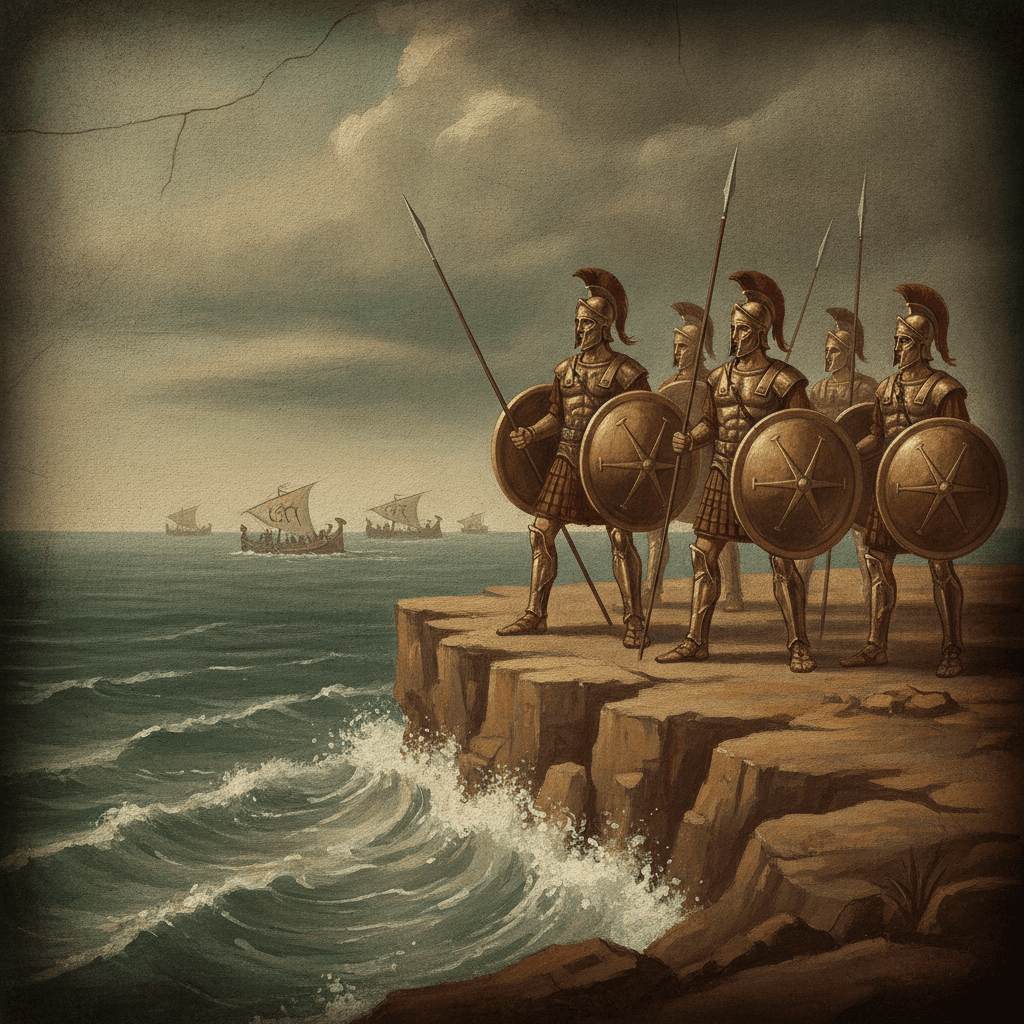
What makes an ancient Greek warrior RPG work?
A convincing Greek-warrior world needs more than red cloaks, crested helmets, and spear lines. The interesting pressure comes from the society behind the shield. Who owns the land? Who makes the weapons? Who receives citizenship? Who is expected to die for a city that never counted them as an equal?
The Bronze Oath begins after Lakedra's proud answer to every question has failed at Keryx Pass. Six thousand marched into the mountains. Four hundred returned. The royal standard is missing, survivors disagree about the final order, and the enemy's ships are already moving down the coast. The crisis makes every old rule negotiable, which also makes every old grievance dangerous.
Choose a fighter, not a fixed hero
You can enter the world as the kind of warrior most people expect: a young shield-bearer trained to stand inside the line. You can also begin outside the citizen ranks as a subject scout, foreign bronzesmith, pankration champion, mounted hunter, healer, pass survivor, or returning exile. Each starting position changes who trusts you and what victory might mean.
| Path | What it puts under pressure |
|---|---|
| Shield-bearer | Discipline, formation, and loyalty to a damaged city |
| Subject scout | Freedom, divided loyalties, and control of the valley roads |
| Bronzesmith | Scarce weapons, labor rights, and the price of citizenship |
| Pankration fighter | Individual courage inside a war built around collective action |
These are openings, not classes that fence you in. A scout can take command. A citizen-warrior can turn against the council. A bronzesmith can become the person who decides which side receives the last good copper on the coast.
The battle is only one of the clocks
The Argent League will reach Lakedra in forty days, but invasion is not the only threat. The River Villages can keep grain moving or starve the city. The Bronze Coast controls the furnaces and shipyards. The surviving Red Cloaks need commanders they once considered politically dangerous. Every faction can help save Lakedra, and every faction has a reason to demand that Lakedra change first.
Then there is Keryx Pass. A false signal fire, orders carrying the king's seal, and a unit that withdrew before the encirclement all point in different directions. Finding the missing royal shield could expose treason, prove a sacrifice, or reveal that the army was sent into an unwinnable battle for reasons that had nothing to do with the enemy.
Heroism without worshipping the war machine
The Bronze Oath makes room for courage without pretending that a militarized society is automatically just. Discipline can save the person beside you. It can also preserve an order built on forced labor and inherited privilege. The world understands why people love Lakedra and why others would risk everything to bring it down.
That gives combat a human cost. Holding a gate may protect a neighborhood whose residents still cannot vote. Opening a road to the enemy may free one village and expose another. The strongest ending is not preselected. You can defend the city, reform it, betray it, join the coalition, find the king, seize command, or help the valley survive both armies.
Questions about The Bronze Oath
Is The Bronze Oath a historical ancient Greek RPG?
It is an original, historically inspired world rather than a reconstruction of one real city or battle. Its shield-wall warfare, civic rivalries, social hierarchy, and material culture draw on ancient Greece, while Lakedra and its crisis remain fictional so your choices can change the outcome.
Can I play a Spartan-style warrior?
Yes. You can begin as a shield-bearer or another disciplined citizen-warrior, but you are not locked into defending the old order. Subject scouts, foreign bronzesmiths, pankration fighters, healers, mounted hunters, and returning exiles all have a place in the crisis.
Is the world only about combat?
No. Battle is approaching, but the deeper struggle concerns citizenship, food, labor, command, and the truth about a military disaster. Negotiation, investigation, reform, betrayal, and alliance-building can matter as much as spear work.
Does The Bronze Oath use magic?
The world is grounded and martial. Its tension comes from people, institutions, terrain, training, and scarce bronze rather than spellcasting or divine intervention.
Can I play The Bronze Oath now?
Yes. The Bronze Oath is live in the Creation OS Showcase. You can borrow the world, choose who you are, and begin at the moment Lakedra starts raising its final levy.
Live in the Showcase. Borrow the world and choose your fighter.