Comparison · Verified 8 August 2026
Craft vs Creation OS: build the system, or enter a world that holds?
Craft and Creation OS can both produce an AI-run roleplaying world, but they are built around different jobs. Craft is a builder's platform. Creation OS is a persistent-world RPG. The right choice depends on whether you want to construct the machine or start living in the world.
The short answer is simple:
- Choose Craft if you want to build, tune and publish an AI RPG system.
- Choose Creation OS if you want to start playing quickly and make a long campaign your main project.
- Choose Friends & Fables if what you specifically want is its established, D&D 5e-shaped tabletop experience.
None of those is a consolation prize. They are different answers to the question of who should do the work before the first meaningful turn: the creator, the platform or the player.
Want to play rather than configure? Start with 200 free Spark. No card required.
Craft vs Creation OS at a glance
| Question | Craft | Creation OS |
|---|---|---|
| Primary job | Build and publish customisable AI RPGs | Enter and play persistent generated worlds |
| Best for | Worldbuilders, system designers and tinkerers | Solo players and groups seeking long campaigns |
| Starting point | Pick a published project or build a world and system | Describe a world and answer a short interview |
| Rules | Creator-defined, including reusable systems | Genre-aware rules handled by the platform |
| Continuity | Depends heavily on how each project is designed | Canonical world facts are maintained for the player |
| Maps and presentation | Hierarchical maps, tokens, expressions and visual-novel tools | Story-first interface, world art, portraits and record surfaces |
| Long-run evidence | No equivalent figure found in the public materials reviewed | Public campaign record sealed at turn 5,011 |
| Pricing shape | Free access plus metered energy and credits | Free first world; Pro is $14.99/month with monthly Spark |
| Current stage | Open beta | Live product |
Verified 8 August 2026. Craft is moving quickly during beta, so its limits and pricing may change.
What Craft actually is
Craft is not simply Friends & Fables with a new coat of paint. Side Quest Labs describes it as a new, system-agnostic approach: let people create not only a world, but the system that governs it.
Its documentation draws the line clearly. Friends & Fables is built around D&D 5e, while Craft supports an existing system, a modified one or something invented from scratch. A project can define its own file types, character sheets, rules, entities, maps and Game Master behaviour. Small packages can then be installed into larger projects.
The live open-beta library already shows what that approach produces. There are fantasy sandboxes, survival games, anime-inspired worlds, custom d20 systems and public projects containing thousands of searchable entries. Some are setting-first. Others provide rules and components meant to be reused by other builders.
Craft also treats presentation as part of authorship. Its current public feature set includes nested maps, movable tokens, character expressions, generated imagery and a visual-novel mode. Its local tooling lets serious creators work with project files outside the web interface and publish changes back to the platform.
That makes Craft closer to a workshop and distribution platform than a single AI RPG. The opportunity is a very high ceiling. The cost of that ceiling is that someone has to build what sits beneath it.
What Creation OS actually is
Creation OS starts from the other direction. It assumes most players do not want to design an RPG engine before they can play an RPG.
You write a concept, answer three to five questions and let Genesis establish the world. The result arrives with places, factions, characters, history, pressures and an opening situation already connected. You then author a character or take the faster generated route and enter Play.
From there, the campaign is the product. Possessions, relationships, standing, objectives, factions, property and other established world facts remain visible through the player's world record. Generated narration can still phrase a minor detail imperfectly, the honest limitation of any LLM narrator, but an established fact is not silently rewritten to fit one loose sentence.
Creation OS also supports different genres without making every player write a new rules package. Fantasy, noir, historical worlds, survival, investigation, cosy play and football-club management can share one entry path while presenting different pressures once play begins.
It offers portraits and visual feedback, but it is not trying to be a universal virtual tabletop or visual-novel construction suite. Its centre of gravity is the continuing world.
The real difference: who owns the difficult parts?
The most important distinction is not which homepage has more features. It is where each product places responsibility.
In Craft, the creator owns the design
Craft lets a builder decide how the Game Master behaves, what types of records exist and what the rules mean. The platform's documentation describes this as more work up front in exchange for direct control.
That is attractive when the system itself is part of your creative work. You may want a custom stress economy, a spell system that does not resemble D&D, a bespoke character sheet or a project that behaves more like a social simulation than an adventure game. Craft gives you surfaces for making those decisions.
It also means quality can vary by project. A carefully built world can provide its Game Master with strong records and clear instructions. A loose project can leave more for the narrator to improvise. Craft is deliberately betting that capable worldbuilders will use its tools to solve different problems in different ways.
In Creation OS, the platform owns continuity
Creation OS does not ask the player to design a memory scheme or decide which campaign records should matter. Canonical world state is part of the product contract.
The visible result is the important part: an object remains owned or sold; a relationship can carry a grudge; a faction keeps its standing; a property continues operating; a consequence can return long after the scene that created it.
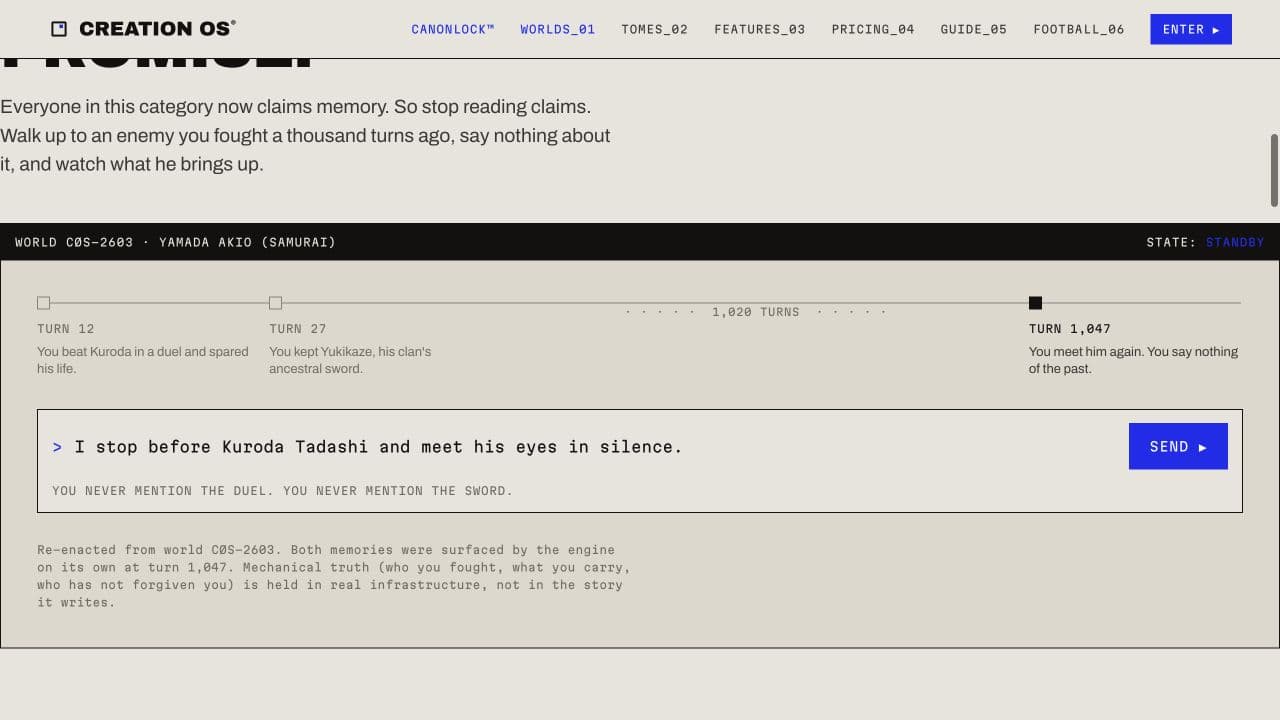
Creation OS publishes a 5,011-turn campaign record so that this claim is not limited to a feature list. It does not prove that generated prose will never slip. It documents one unusually long, inspectable Creation OS world artifact.
Maps, tokens and generated media versus persistent state
Craft makes visual creation central. Maps can move from large regions into smaller locations. Characters can have expression sets. A project can present scenes like a visual novel. Builders can produce and organise large libraries of illustrated world material.
That is not a gimmick. For some players, the map is the game. Tactical position, tokens, portraits and scene art provide information and atmosphere that text alone cannot.
The tradeoff is that a striking scene does not by itself establish durable canon. Craft gives builders tools for context and state, but the project's design determines how well those tools are used. Its own documentation advises creators to control what is always visible to the model and what is retrieved only when needed.
Creation OS makes the opposite emphasis. Visuals support the world, while the record decides what remains true. The strongest comparison is therefore not “pretty versus serious.” It is author-controlled presentation versus platform-managed continuity.
If you want to construct a visual campaign surface, Craft is the stronger fit. If your test is whether an old enemy still has the right reason to hate you hundreds of turns later, Creation OS is built around that test.
Which is easier to start?
Both products let you play without building everything yourself, but their natural workflows differ.
Craft has a discovery library of published worlds. Pick a finished project and you can avoid most of the creator tooling. When you do build, however, the product opens into projects, systems, file types, layouts, maps, instructions, packages and publishing. That depth is the appeal, but it is still depth to learn.
Creation OS is intentionally narrower at the door:
- Describe who you want to be and the kind of world you want.
- Answer a few questions about the choices your concept leaves open.
- Let Genesis build the connected setting.
- Create or generate a character.
- Take the first action.
If you enjoy configuring the machine, Craft offers more levers. If configuration is the thing keeping you from playing, Creation OS removes most of them.
Which gives you more control?
Craft wins on system-level control. That is its reason to exist.
Creators can define rules, custom records, layouts and Game Master instructions, combine reusable packages and choose how a project exposes information during play. The live documentation is unusually candid about the tradeoff: a general interface cannot be as specifically tailored to every system as a product dedicated to one experience.
Creation OS gives the player control through action rather than configuration. You choose what your character attempts, which opportunities to pursue, whom to trust and what to build. You are not expected to edit the world's underlying rules or manually maintain every record.
One is control over the game. The other is agency inside the game.
Which is better for a long campaign?
This is the comparison where evidence matters most.
Craft gives a serious builder tools for making a long-running project: large file collections, project-defined records, controlled context, versioned releases and reusable systems. Its flexibility means there is no honest platform-wide number that describes how every Craft world will behave. A project's endurance depends partly on how it was made.
Creation OS standardises the continuity job and publishes one long-run result: a campaign sealed at turn 5,011 with its world record still available to inspect. That does not make Creation OS the winner for every possible RPG. It makes it the safer choice when accumulated state is the main event.
- Choose Craft to build the long-campaign system in your head.
- Choose Creation OS to begin the long campaign you want to live through.
Pricing and usage
Craft uses free access plus metered energy and credits. AI chat, image generation and other paid AI features draw from that balance, and usage varies with the model, context and media selected. During beta, exact allowances and plan details can change, so check Craft's current pricing before committing to a large build.
According to its current pricing page, Creation OS gives new players 200 Spark, a first world, full play and one checkpoint without a card. Author Pro is $14.99 per month and includes 1,500 Spark per billing cycle, unlimited built worlds, Tome access, additional checkpoints and monthly Art Forge portraits. Play currently costs three Spark per turn, and one-off Spark packs are available.
Neither model is literally cost-free at unlimited scale. Craft meters a configurable range of models and media. Creation OS meters play and creation through Spark. Compare the experience you will actually use, not only the cheapest number on each pricing page.
Who should choose Craft?
- Designing the rules is part of the fun.
- You want custom sheets, entities, maps and layouts.
- Visual-novel presentation or tactical maps matter heavily.
- You want to publish modular content for other creators.
- You are comfortable tuning instructions and context.
- You want to work with a world as editable project files.
Who should choose Creation OS?
- You want to reach the first turn quickly.
- You want the platform to maintain canonical world facts.
- You care more about accumulating consequences than building maps.
- You want one concept expanded into a connected world.
- You want genre freedom without writing a new rules package.
- A public 5,000-turn record matters more than a theoretical claim.
- You want solo play or an asynchronous shared world that can continue between schedules.
Final verdict
Craft and Creation OS point towards two different futures for AI RPGs.
Craft imagines a creator ecosystem: give people a flexible workshop, let them invent systems and worlds, then let players choose from what the community builds. Its best experiences may become extremely ambitious because their creators can shape almost everything.
Creation OS imagines a durable world: remove the setup burden, keep established facts on the record and let the player spend their time making choices inside it. Its ambition is measured less by the number of creator controls than by how much history a world can carry.
Build the machine: choose Craft.
Enter the world and stay: choose Creation OS.
Frequently asked questions
Is Craft replacing Friends & Fables?
Craft is a separate product from the same team and is described by its makers as the broader future of their AI RPG work. The team says Friends & Fables will continue as the easier D&D 5e-shaped option, while Craft is the system-agnostic builder platform.
Is Craft an AI RPG or an AI RPG builder?
It is both. Players can enter published projects, while creators can build worlds, systems, maps, records, layouts and Game Master behaviour. The builder layer is what most clearly distinguishes it.
Does Craft have persistent memory?
Craft gives project creators tools to determine what the Game Master can use and how campaign information is organised. Because projects can be designed differently, memory quality is partly project-dependent. We did not find one platform-wide endurance figure in the public Craft materials reviewed.
Does Creation OS have maps and AI art?
Creation OS includes world art, portraits and visual feedback, but it is not designed as a universal visual tabletop. Its main product surfaces are the narrative and the persistent world record.
Which is better for non-D&D games?
Both support experiences beyond D&D, in different ways. Craft lets creators build or import a custom system. Creation OS lets players describe a world in many genres and have the platform handle the experience without requiring them to author a rules package.
Which is better for players who do not want to build anything?
Creation OS offers the more direct route from an idea to a generated, playable world. Craft players can choose a published community project, but its distinctive strength is the construction layer.
Which one has better long-term memory?
Creation OS has the stronger public endurance evidence: a sealed, inspectable campaign record at turn 5,011. Craft provides flexible record-building tools, but results can vary by project. We did not find an equivalent platform-wide long-run figure in the Craft materials reviewed for this comparison.
Verification and sources
This comparison was prepared by Creation OS and last verified on 8 August 2026. Craft's live open-beta interface and public documentation were inspected, including its discovery library. No paid Craft credits were spent, and this article does not claim a controlled long-run Craft playtest.
ENTER THE WORLD AND STAY
Start with 200 free Spark. Build your first world without entering card details.